Description
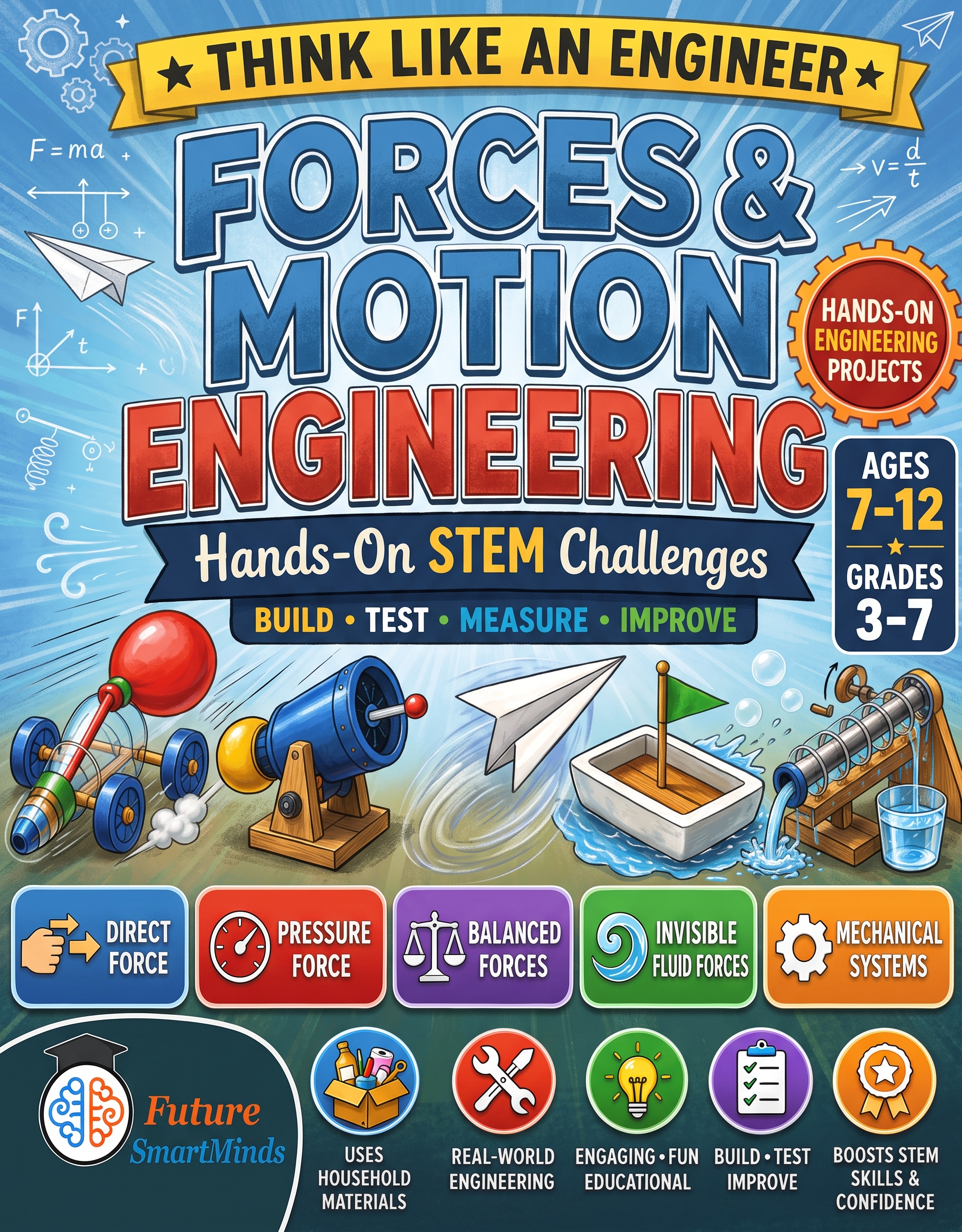
Forces & Motion Engineering: Hands-On STEM Projects for Kids Ages 7–12
Design, build, test, measure, and improve real engineering systems!
Turn forces and motion into an exciting hands-on engineering adventure. In Forces & Motion Engineering, young engineers ages 7–12 move beyond simple science experiments to design working systems, investigate how they perform, collect measurements, troubleshoot problems, and improve their creations.
Through five complete engineering challenges, children explore forces, motion, air pressure, flight, surface tension, fluid forces, and mechanical systems using accessible household and classroom materials.
Part of the five-book Think Like an Engineer series, this book emphasizes meaningful investigation and engineering design rather than quick, one-time activities.
Our engineering approach: PLAN → BUILD → TEST → MEASURE → IMPROVE
Five Hands-On Engineering Challenges
1. Build a Balloon-Powered Car
Design a moving car powered by escaping air. Investigate how forces affect motion, measure distance and time, calculate speed, and improve stability and performance.
2. Launch a High-Pressure Air Cannon
Create a classroom air-pressure launcher using lightweight objects. Explore how moving air transfers force, measure launching distance and accuracy, and test improvements to the design.
3. Design a Turbo Glider
Build a double-hoop glider and investigate how thrust, lift, drag, gravity, and balance affect flight. Measure flight distance and time, calculate speed, and compare different designs.
4. Build a Soap-Powered Boat
Create a miniature boat that moves across water without batteries or motors. Investigate surface tension, measure movement and speed, compare trials, and improve the boat’s design.
5. Engineer a Water-Lifting System
Complete a capstone engineering challenge by constructing a rotating screw-pump model. Measure the quantity of water lifted, calculate flow rate, and investigate how slope, rotation, and scooping affect performance.
What Young Engineers Will Learn
- Understand forces, pressure, motion, flight, and fluid behaviour.
- Design and construct simple working engineering systems.
- Measure distance, time, speed, and water flow.
- Record observations and compare experimental results.
- Identify variables that influence performance.
- Troubleshoot problems and improve designs using evidence.
- Develop logical thinking, creativity, and engineering problem-solving skills.
What’s Included in the PDF Book
- Five complete engineering projects with illustrated step-by-step instructions.
- Materials lists using accessible household and classroom supplies.
- Science and engineering explanations connected to real-world applications.
- Testing tables, measurements, and simple calculations.
- Troubleshooting guidance and structured design-improvement activities.
- Reflect & Explain questions to encourage deeper understanding.
- A final water-lifting system capstone challenge.
Real Engineering with Accessible Materials
Projects use familiar supplies such as balloons, bottles, straws, cardboard, paper, tape, bottle caps, soap, tubing, rulers, timers, and water containers.
The activities help children discover that engineering is not simply about making something work. It is about understanding why it works, how well it performs, and how it can be improved.
Safety note: Adult supervision is required when cutting materials, preparing holes, and assembling moving systems. Activity materials and liquids must not be consumed.
Who Is This Book For?
Designed for children ages 7–12, including:
- Curious young builders and future engineers.
- Parents looking for meaningful hands-on STEM learning.
- Homeschool families exploring science and engineering.
- Teachers seeking engineering investigations for classroom enrichment.
- STEM clubs and project-based learning programs.
Digital PDF Edition
Price: $7.77
Purchase the PDF edition directly from Future Smart Minds and download your book after checkout. Read on a compatible computer or tablet, or print selected activity pages for personal or classroom use, subject to the book’s licence terms.
Prefer a printed copy? The physical edition is available separately through Amazon.
Part of the Think Like an Engineer Series
Forces & Motion Engineering is the first book in a five-book series that helps children investigate engineering through hands-on challenges across forces and motion, electricity and magnetism, energy systems, renewable energy, and environmental engineering.
Give young learners the opportunity to think like engineers: plan, build, test, measure, improve, and discover what makes a design work.