Description
Electricity & Magnetism Engineering: Hands-On STEM Projects for Kids Ages 7–12
Build, test, measure, and improve electrical and magnetic systems!
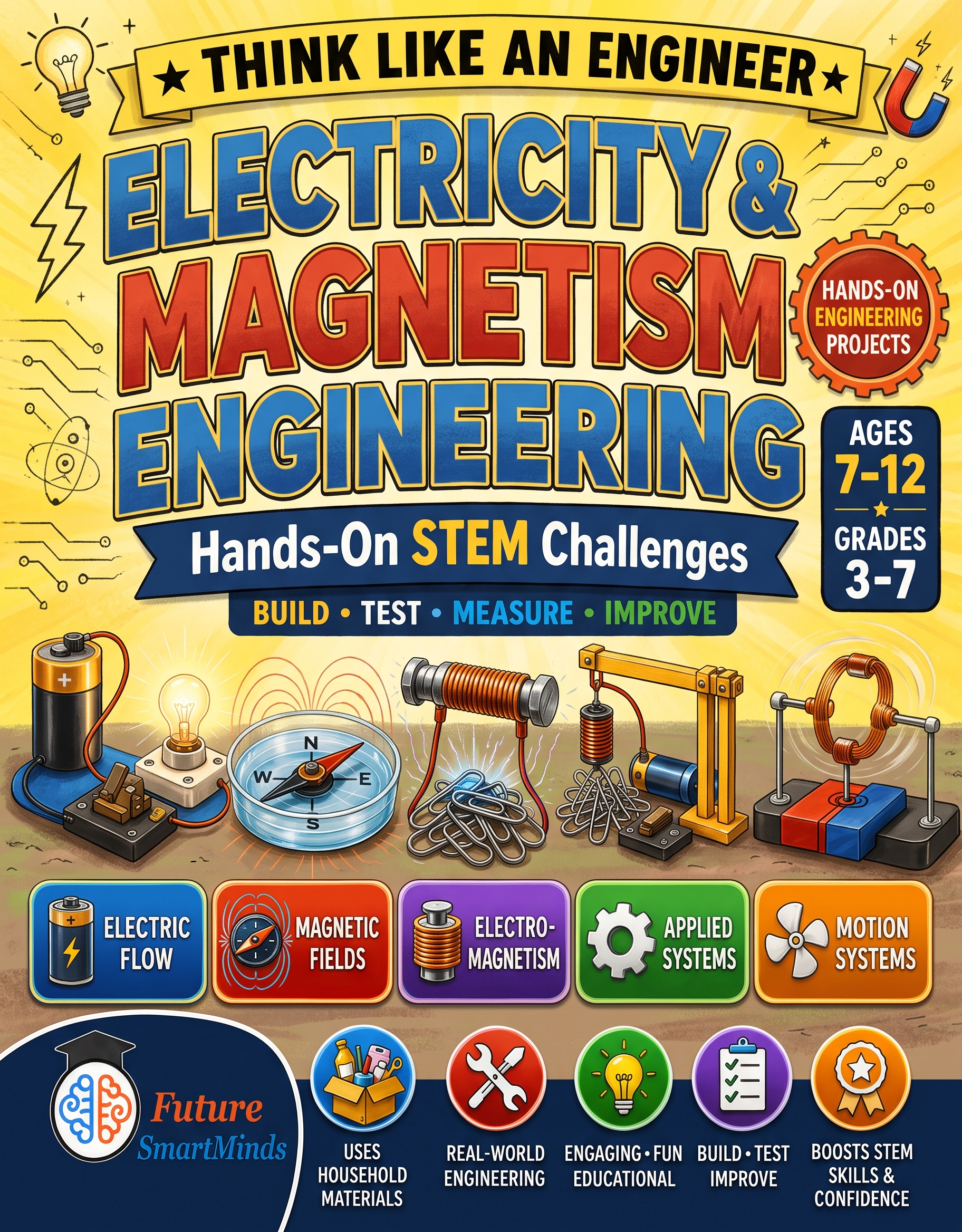
Turn electricity and magnetism into exciting hands-on engineering experiences. In Electricity & Magnetism Engineering, young engineers ages 7–12 discover how electrical and magnetic forces work together by designing and building real working systems—from a simple circuit and magnetic compass to a powerful electromagnet, electromagnetic crane, and spinning electric motor.
Through five complete, connected engineering challenges, children develop a deeper understanding of circuits, magnetism, electromagnetic forces, motion, and control. They don’t simply assemble projects and observe results. They collect measurements, compare designs, identify problems, and use evidence to improve performance.
Part of the five-book Think Like an Engineer series, this book emphasizes engineering depth over activity count, giving young learners opportunities to investigate how systems work and how engineers make them more effective, measurable, safe, and reliable.
Our engineering approach: PLAN → BUILD → TEST → MEASURE → IMPROVE
Five Hands-On Engineering Challenges
1. Light Up a Circuit System
Build a working electrical circuit and investigate how electricity flows through connected components. Test repeated connections, calculate reliability, compare battery and bulb arrangements, and add a switch to control the system.
Engineering skills: Circuit design, testing, measurement, troubleshooting, and reliable control.
2. Design a Magnetic Compass
Discover how magnetism can help determine direction. Magnetize a needle, create a low-friction floating platform, and investigate how the compass responds to magnetic forces.
Measure settling time, compare directional reliability, and improve stability while investigating magnetic interference.
Engineering skills: Magnetic testing, observation, measurement, stability, and precision.
3. Create a Powerful Electromagnet
Combine electric current, a wire coil, and a metal core to create controllable magnetism. Investigate how changing the number of coil turns and battery arrangements influences lifting performance.
Measure lifting capacity, compare results, and develop reliable ON/OFF control.
Engineering skills: Electromagnetic design, controlled experiments, performance measurement, and optimization.
4. Build an Electromagnetic Crane
Combine electricity, magnetism, structure, and control to design a working lifting system.
Measure how effectively the crane lifts and transfers objects, assess stability and reliability, and improve the system using evidence from repeated testing.
Engineering skills: System integration, lifting capacity, transfer efficiency, structural stability, and reliability.
5. Build a Spinning Electric Motor
Complete the capstone project by building a working electric motor that converts electrical energy into rotating mechanical motion.
Use a wire coil and permanent magnet to investigate magnetic interaction, count rotations, estimate revolutions per minute (RPM), evaluate smoothness, and improve the motor’s balance and performance.
Engineering skills: Electromechanical systems, rotational motion, RPM estimation, troubleshooting, and performance improvement.
What Young Engineers Will Learn
- Understand how simple electrical circuits work.
- Explore magnetic forces, magnetic direction, and interference.
- Discover how electric current can create controllable magnetism.
- Combine electrical, magnetic, and mechanical components into functioning systems.
- Measure lifting capacity, settling time, reliability, efficiency, and rotational speed.
- Conduct repeated tests, calculate averages and percentages, and compare experimental results.
- Identify variables, troubleshoot problems, and improve engineering designs.
- Develop logical thinking, creativity, persistence, and evidence-based problem-solving skills.
What’s Included in the PDF Book
- Five complete electricity and magnetism engineering projects.
- Colorful, illustrated step-by-step instructions and diagrams.
- Accessible household and classroom materials lists.
- Clear science explanations and real-world engineering connections.
- Testing tables, observations, and simple calculations.
- Structured troubleshooting and design-improvement challenges.
- Reflect & Explain questions to strengthen understanding.
- Complete answer keys.
- A final spinning electric-motor capstone project.
More Than Quick Science Experiments
This book encourages children to think beyond getting a project to work once.
They repeat trials, collect data, calculate averages and percentages, assess reliability and efficiency, and investigate how changing individual components affects performance.
Each challenge reinforces an important engineering principle: successful systems should be measurable, controllable, safe, and reliable.
By combining observations with calculations and testing, children begin to understand how engineers use evidence to make better design decisions.
Hands-On Learning with Accessible Materials
Activities use familiar classroom and household materials, along with basic electrical and magnetic components such as batteries, wires, magnets, coils, switches, and small metal objects.
Projects are designed for guided hands-on learning and do not require advanced laboratory equipment.
Safety note: Adult supervision is required when preparing materials and assembling electrical or mechanical systems. Use only the low-voltage battery arrangements specified in the activities. Never connect projects to household mains electricity. Follow the book’s instructions and safety precautions.
Who Is This Book For?
Designed for children ages 7–12, including:
- Curious young engineers interested in electricity, magnets, and motors.
- Parents seeking meaningful, screen-free STEM projects.
- Homeschool families exploring electricity and magnetism.
- Teachers looking for structured engineering challenges.
- STEM classrooms, clubs, makerspaces, and enrichment programs.
- Young learners who enjoy building, testing, and discovering how technology works.
Digital PDF Edition
Purchase the illustrated PDF edition directly from Future Smart Minds and download it after checkout.
The book can be read on a compatible computer or tablet, and selected activity pages can be printed according to the licence supplied with your purchase.
Prefer a physical book? The paperback edition is available separately on Amazon.
Part of the Think Like an Engineer Series
Electricity & Magnetism Engineering is the second book in the five-book Think Like an Engineer series.
The collection develops engineering skills across five areas:
- Forces & Motion Engineering
- Electricity & Magnetism Engineering
- Energy Systems Engineering
- Renewable Energy Engineering
- Environmental Engineering
Each book introduces practical engineering concepts through connected challenges that encourage children to design, construct, measure, analyze, troubleshoot, and improve working systems.
From lighting a simple circuit to building a spinning electric motor, give young learners the opportunity to discover how electricity and magnetism become useful engineering technology.
Start building, testing, measuring, improving—and thinking like an engineer!