Description
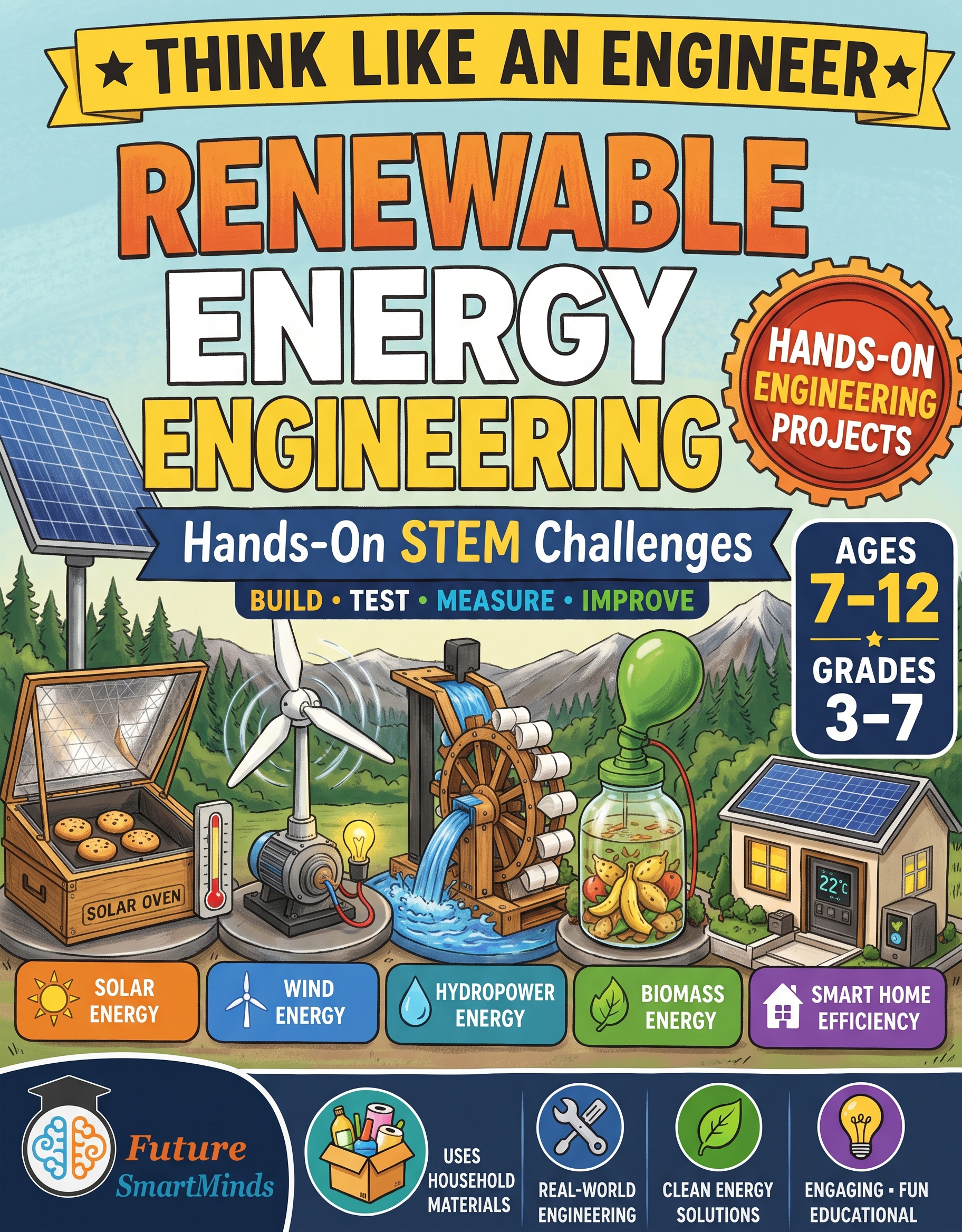
Renewable Energy Engineering: Hands-On STEM Projects for Kids Ages 7–12
Build, test, measure, and improve renewable energy systems using solar, wind, hydropower, biomass, and smart-home design!
Put clean energy into the hands of young engineers! In Renewable Energy Engineering, children ages 7–12 explore how sunlight, moving air, flowing water, and biomass can be captured, converted, and used in practical engineering systems.
Through five complete, connected engineering challenges, young learners investigate how renewable energy systems work, measure performance, compare designs, troubleshoot problems, and discover how engineering decisions influence efficiency and reliability.
Rather than rushing through quick demonstrations, each activity offers opportunities for controlled testing and progressive improvements. The journey concludes with a Smart Energy Home capstone project, where children bring together renewable energy, energy efficiency, storage, insulation, and water-management concepts.
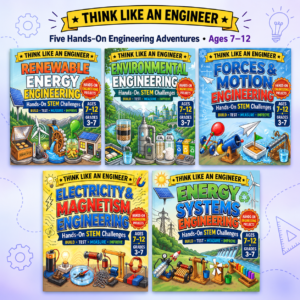
Part of the five-book Think Like an Engineer series, this book emphasizes engineering depth over activity count, helping children move from scientific understanding to practical engineering design.
Our engineering approach: PLAN → BUILD → TEST → MEASURE → IMPROVE
Five Hands-On Renewable Energy Challenges
1. Build a Solar Oven System
Design a solar oven that captures sunlight and converts it into heat.
Measure temperature increases and investigate how reflection, insulation, and positioning affect solar heating. Compare different arrangements and improve the design to capture and retain more heat.
Engineering skills: Solar thermal energy, heat transfer, temperature measurement, insulation, and design optimization.
2. Build a Wind-Powered Generator
Investigate how moving air can be converted into mechanical rotation and electrical energy.
Design turbine blades, use airflow to rotate a small motor, observe LED response, compare blade performance, and improve the system through repeated testing.
Engineering skills: Wind-energy conversion, turbine blade design, rotational motion, electrical generation, and performance testing.
3. Build a Hydropower Generator
Explore how flowing water can transfer energy to a turbine and produce an electrical response.
Build a simple hydropower system, observe the turbine’s movement and electrical output, count rotations, compare trials, and improve energy transfer.
Engineering skills: Hydropower, turbine systems, mechanical-to-electrical energy conversion, measurement, and troubleshooting.
4. Build a Mini Biogas Energy System
Investigate how biological processes can produce gas using a safe yeast-and-sugar model.
Observe gas production, measure changes in balloon circumference, compare results, and connect the model to the principles behind real biogas energy systems.
Engineering skills: Biomass energy concepts, gas production, observation, controlled testing, measurement, and scientific interpretation.
This activity models biological gas production; it does not collect, burn, or use combustible biogas.
5. Design an Energy-Efficient Smart Home
Complete the capstone challenge by designing a model home that combines renewable-energy and energy-efficiency strategies.
Investigate insulation, sealing, renewable energy, energy storage, and water-management ideas to develop an integrated home design.
Consider how different building systems interact and how thoughtful design choices can reduce energy needs and improve performance.
Engineering skills: Integrated systems design, building energy efficiency, renewable energy planning, system interactions, and sustainable engineering.
What Young Engineers Will Learn
- Understand how sunlight, wind, moving water, and biomass relate to renewable energy.
- Investigate how energy can be captured, converted, and managed.
- Explore solar heating, turbine rotation, electrical generation, and biological gas production.
- Design simple renewable-energy systems using accessible materials.
- Measure temperature, turbine rotations, electrical response, and balloon circumference.
- Compare repeated trials and explain results using evidence.
- Identify variables that affect efficiency, reliability, and system performance.
- Troubleshoot problems and improve engineering designs.
- Explore how renewable energy and efficiency measures can work together in buildings.
- Develop creativity, critical thinking, experimental reasoning, and problem-solving skills.
What’s Included in the PDF Book
- Five complete renewable-energy engineering projects.
- Colorful, illustrated step-by-step instructions and diagrams.
- Accessible household and classroom materials lists.
- Clear explanations of renewable-energy concepts and real-world applications.
- Testing tables, observations, and simple calculations.
- Three structured improvement levels for each activity.
- Troubleshooting guidance and engineering design challenges.
- Reflect & Explain questions that reinforce understanding.
- A final Smart Energy Home design capstone.
More Than Simple STEM Crafts
Children do more than build and observe.
They record temperature changes, count turbine rotations, investigate electrical response, measure balloon growth, compare results, and explain how design changes affect performance.
Each project includes three structured improvement levels that encourage children to test ideas, change variables, analyze evidence, and improve their designs.
Through this approach, young learners discover that effective renewable-energy systems need to be measurable, efficient, reliable, and thoughtfully designed.
Real Engineering with Accessible Materials
Projects use familiar household and classroom supplies such as cardboard, bottles, foil, paper, tape, balloons, yeast, sugar, and simple reusable electrical components.
Adult supervision is recommended when cutting materials and working with lamps, warm water, motors, wires, skewers, or flowing water.
Safety note: Follow the specific instructions and precautions for each activity. Use only approved low-voltage electrical components. Never connect experimental projects to household mains electricity. Do not consume experiment materials.
Who Is This Book For?
Designed for children ages 7–12, including:
- Curious young engineers interested in renewable energy and sustainability.
- Parents looking for meaningful hands-on STEM activities.
- Homeschool families investigating energy and the environment.
- Teachers planning renewable-energy or sustainability lessons.
- STEM classrooms, engineering clubs, makerspaces, and enrichment programs.
- Earth Day and environmental science learning activities.
- Young learners who enjoy building, testing, and solving practical problems.
Digital PDF Edition
Purchase the illustrated PDF edition directly from Future Smart Minds and download your book after checkout.
Read on a compatible computer or tablet, or print selected activity pages according to the licence supplied with your purchase.
Prefer a physical book? The paperback edition is available separately through Amazon.
Part of the Think Like an Engineer Series
Renewable Energy Engineering is the fourth book in the five-book Think Like an Engineer series:
- Forces & Motion Engineering
- Electricity & Magnetism Engineering
- Energy Systems Engineering
- Renewable Energy Engineering
- Environmental Engineering
Each book helps children develop engineering thinking through structured projects focused on planning, building, testing, measuring, troubleshooting, and improvement.
From capturing sunlight to designing a Smart Energy Home, discover how engineers transform renewable-energy ideas into practical systems.
Start building, testing, measuring, and improving—and explore the engineering solutions shaping a more sustainable future!