Description
Energy Systems Engineering: Hands-On STEM Projects for Kids Ages 7–12
Build, test, measure, and improve systems that store, transfer, and transform energy!
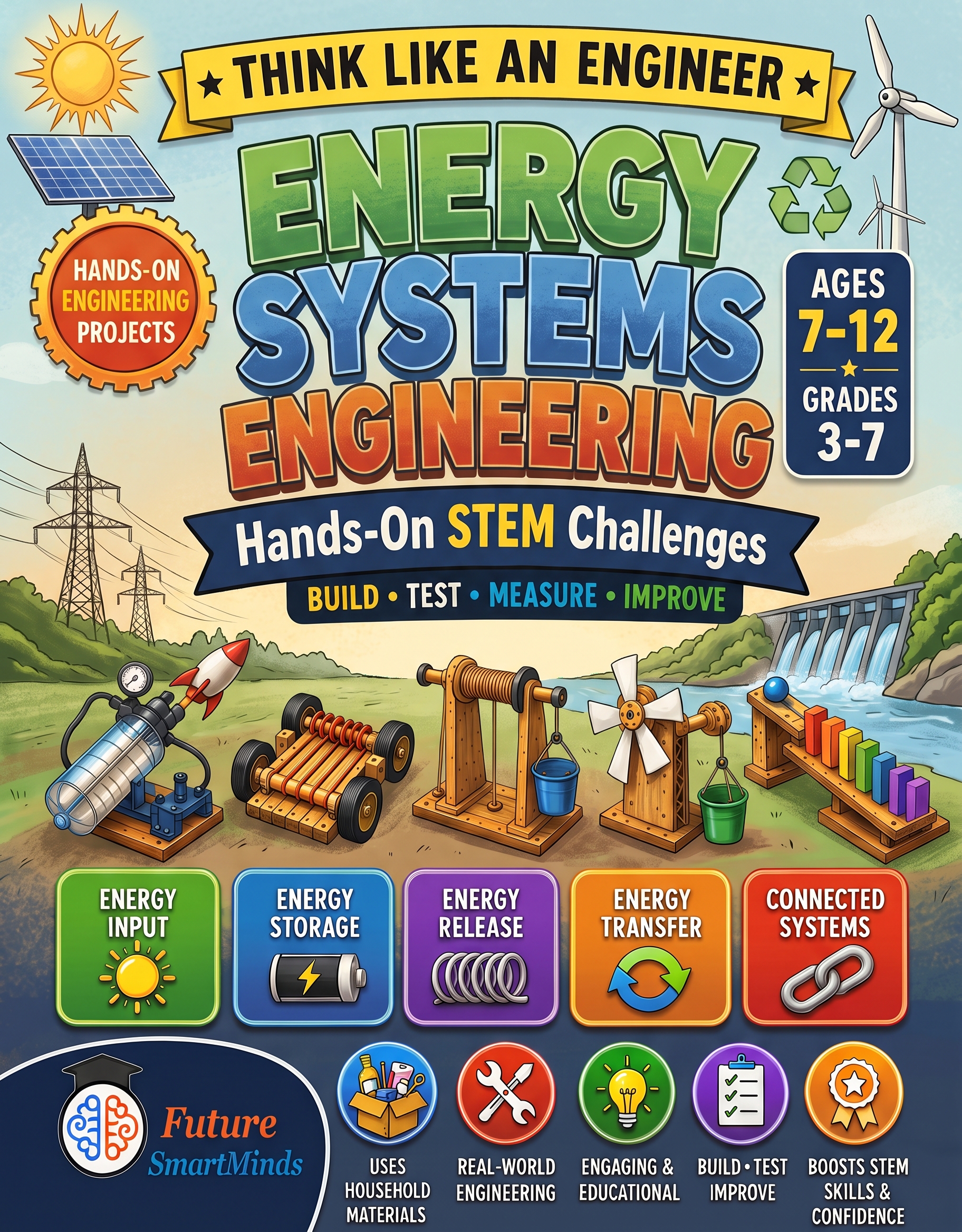
Turn energy into an exciting hands-on engineering adventure. In Energy Systems Engineering, young engineers ages 7–12 discover how energy can be stored, released, transferred, and transformed by creating working systems that launch, roll, lift, spin, and trigger connected actions.
Through five complete engineering challenges, children investigate where energy begins, how it moves through a system, what influences performance, and why some designs work more reliably than others.
Rather than simply building projects and watching them work, learners repeat tests, collect measurements, compare results, identify problems, and make controlled design improvements based on evidence.
Part of the five-book Think Like an Engineer series, this book emphasizes engineering depth over activity count, giving children opportunities to understand the science behind each system and discover how thoughtful engineering decisions can improve performance.
Our engineering approach: PLAN → BUILD → TEST → MEASURE → IMPROVE
Five Hands-On Engineering Challenges
1. Build a Compressed-Air Launcher
Create a bottle-powered air launcher and investigate how compressed air stores and releases energy to produce motion.
Conduct repeated launches, measure performance, assess reliability, identify possible air leaks, and compare controlled changes to improve the system.
Engineering skills: Air-pressure systems, energy release, testing, reliability, and troubleshooting.
2. Create a Rubber Band-Powered Car
Design a moving car that stores elastic potential energy in a twisted rubber band and transfers it through the axle and wheels.
Measure travel distance and directional drift, compare multiple trials, and investigate how changes to the wheels, axles, and structure affect stability and reliability.
Engineering skills: Elastic potential energy, mechanical energy transfer, motion, measurement, and design optimization.
3. Build a Gravity-Powered Lift System
Investigate how gravitational potential energy can be stored and used to perform useful work.
Raise a drive weight to store energy, then release it to rotate an axle and lift a cup. Compare starting height, drive weight, load, and lifting performance.
Engineering skills: Gravitational potential energy, rotational motion, mechanical lifting, controlled testing, and performance analysis.
4. Build a Wind-Powered Lifting System
Create a small wind-powered turbine that converts moving air into rotational motion and then into lifting work.
Measure lift time, final lifting height, and system reliability. Experiment with turbine blades and loads to understand how design choices influence performance.
Engineering skills: Wind energy conversion, turbine design, rotational motion, lifting systems, and efficiency.
5. Design an Energy Transfer Chain Reaction
Complete the capstone engineering challenge by creating a connected system using ramps, marbles, dominoes, collisions, triggers, and a final target.
Investigate how energy transfers from one stage to the next. Track each stage, measure completion time, calculate reliability, and improve the chain reaction so the entire system operates dependably.
Engineering skills: Multi-stage system integration, energy transfer, sequencing, reliability, troubleshooting, and optimization.
What Young Engineers Will Learn
- Understand the difference between stored energy and energy in motion.
- Explore elastic, gravitational, and mechanical energy.
- Investigate how compressed air and moving wind can perform useful work.
- Design systems that transfer energy between connected components.
- Measure distance, time, lifting performance, and reliability.
- Calculate averages and percentages to compare engineering trials.
- Identify variables that affect stability and performance.
- Troubleshoot failures and improve designs using experimental evidence.
- Develop logical thinking, creativity, persistence, and engineering problem-solving skills.
What’s Included in the PDF Book
- Five complete energy systems engineering projects.
- Colorful, illustrated step-by-step instructions and diagrams.
- Accessible household and craft materials lists.
- Clear explanations of energy concepts and their real-world applications.
- Testing tables, observations, and simple calculations.
- Structured troubleshooting and design-improvement challenges.
- Reflect & Explain questions to reinforce learning.
- Complete answer keys.
- A final energy-transfer chain-reaction capstone project.
More Than Quick Science Experiments
Children do more than make objects move and observe what happens.
They repeat trials, measure distance and time, analyze lifting performance, calculate averages and reliability percentages, compare designs, and investigate why a system succeeds or fails.
Each activity encourages children to change one variable at a time and use results to make informed improvements.
These investigations reinforce an important engineering principle: successful systems should be measurable, stable, safe, dependable, and capable of transferring energy effectively.
Hands-On Learning with Accessible Materials
Projects use familiar household and classroom supplies, including bottles, balloons, rubber bands, cardboard, wheels, axles, string, weights, paper, marbles, dominoes, and simple craft materials.
The book is designed for guided hands-on STEM learning without requiring advanced laboratory equipment.
Safety note: Adult supervision is required when preparing materials, assembling moving systems, and testing launchers, weights, and other mechanisms. Follow the safety instructions provided for each activity. Never aim launchers toward people or animals.
Who Is This Book For?
Designed for children ages 7–12, including:
- Curious young engineers interested in energy and motion.
- Parents seeking meaningful, screen-free STEM projects.
- Homeschool families exploring energy concepts.
- Teachers looking for structured engineering challenges.
- STEM classrooms, clubs, makerspaces, and enrichment programs.
- Young learners who enjoy designing, experimenting, and solving real-world problems.
Digital PDF Edition
Purchase the illustrated PDF edition directly from Future Smart Minds and download it after checkout.
Read on a compatible computer or tablet, or print selected activity pages in accordance with the licence provided with your purchase.
Prefer a physical book? The paperback edition is available separately through Amazon.
Part of the Think Like an Engineer Series
Energy Systems Engineering is the third book in the five-book Think Like an Engineer series.
The collection introduces children to engineering through five connected subject areas:
- Forces & Motion Engineering
- Electricity & Magnetism Engineering
- Energy Systems Engineering
- Renewable Energy Engineering
- Environmental Engineering
Each book encourages children to apply scientific understanding through engineering design, measurement, troubleshooting, and improvement.
From launching and rolling to lifting and creating chain reactions, discover how energy can be engineered to perform useful work.
Start planning, building, testing, measuring, and improving—and think like an engineer!