Description
Environmental Engineering: Hands-On STEM Projects for Kids Ages 7–12
Build, test, measure, and improve solutions for pollution control, clean water, carbon capture, and recycling!
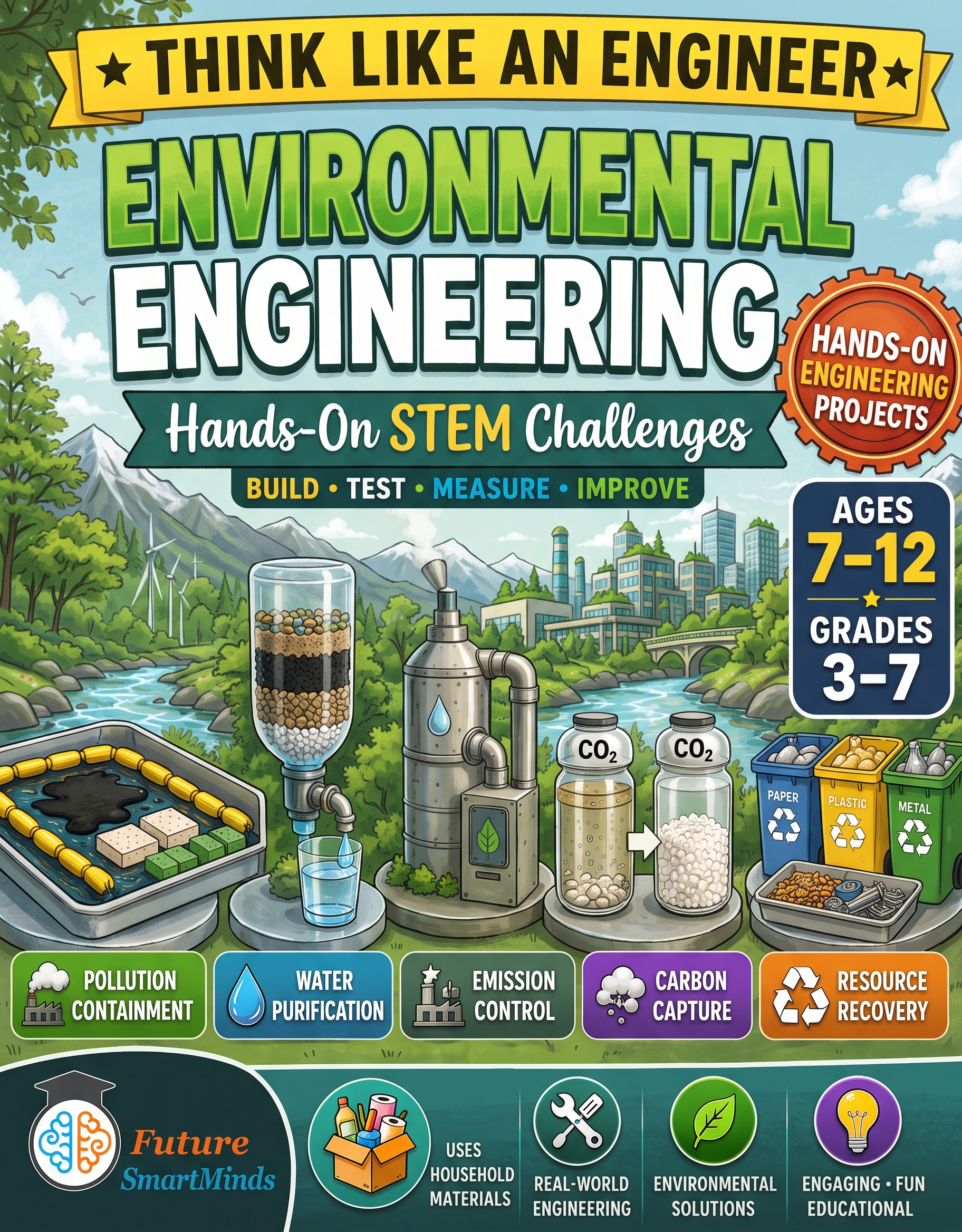
Put environmental problem-solving into the hands of young engineers! In Environmental Engineering, children ages 7–12 discover how engineers protect water, reduce pollution, control emissions, investigate carbon dioxide capture, and recover useful materials by designing and testing their own working models.
Through five connected engineering challenges, young learners explore real environmental problems and investigate practical approaches to solving them. They measure performance, compare designs, identify problems, troubleshoot failures, and improve their systems using experimental evidence.
Rather than rushing through disconnected science demonstrations, each activity encourages children to understand how a system works, investigate variables, and make thoughtful design improvements.
Part of the five-book Think Like an Engineer series, this book emphasizes engineering depth over activity count, helping children connect scientific understanding with practical engineering solutions.
Our engineering approach: PLAN → BUILD → TEST → MEASURE → IMPROVE
Five Hands-On Environmental Engineering Challenges
1. Build an Oil Spill Containment System
Explore how engineers contain and recover oil from polluted water.
Design a floating containment boom, investigate how different cleanup materials absorb or collect oil, and measure recovery performance.
Compare results and test design modifications that improve containment and cleanup effectiveness.
Engineering skills: Pollution containment, materials testing, oil recovery measurement, controlled experiments, and system improvement.
2. Build a Water Filtration System
Investigate how engineering systems remove visible particles from water.
Construct layered filters using materials such as sand, gravel, and cotton. Compare filtered-water clarity, water recovery, flow time, and overall performance.
Experiment with filter arrangements and identify ways to improve water flow and particle removal.
Engineering skills: Water filtration, materials selection, flow measurement, performance comparison, and optimization.
This is a filtration-learning model. Filtered water is not necessarily safe to drink and must not be consumed.
3. Build a Smokestack Scrubber System
Discover how environmental engineers use treatment systems to reduce pollutants in industrial emissions.
Build a model scrubber system, compare treatment materials, measure changes in pH, and investigate how flow, clogging, and system reliability affect performance.
Use measurements to compare designs and improve the model.
Engineering skills: Emissions-treatment concepts, pH measurement, fluid flow, material comparison, and system reliability.
4. Build a Carbon Capture Mineralization System
Investigate how carbon dioxide can react with materials to form visible mineral products.
Guide model carbon dioxide through two capture stages, observe evidence of mineral formation, and evaluate the system’s performance.
Compare experimental results and investigate how design changes affect the capture process.
Engineering skills: Carbon capture concepts, chemical reactions, mineralization, observation, controlled testing, and system evaluation.
5. Build a Recycling Recovery System
Complete the environmental engineering capstone by designing a system for sorting, recovering, and reusing materials.
Investigate material separation, reduce contamination, measure recovery performance, and create useful model products from recovered resources.
Explore how better sorting and recovery systems can reduce waste and support resource conservation.
Engineering skills: Recycling systems, material recovery, contamination measurement, resource efficiency, and integrated system design.
What Young Environmental Engineers Will Learn
- Understand how engineers develop solutions to environmental problems.
- Explore pollution containment, water filtration, emissions treatment, carbon capture, and recycling.
- Design and build working environmental engineering models.
- Measure oil recovery, water clarity, flow time, pH change, and material recovery.
- Observe evidence of mineral formation and investigate carbon dioxide reactions.
- Explore contamination, absorption, and packing density.
- Compare experimental trials and identify variables that affect performance.
- Troubleshoot problems and improve engineering designs using evidence.
- Recognize why environmental systems must be measurable, reliable, safe, and thoughtfully designed.
- Develop critical thinking, creativity, experimental reasoning, and environmental problem-solving skills.
What’s Included in the PDF Book
- Five complete environmental engineering projects.
- Colorful, illustrated step-by-step instructions and diagrams.
- Accessible household and classroom materials lists.
- Science explanations connected to real environmental challenges.
- Testing tables, observations, and simple calculations.
- Three structured improvement levels for each activity.
- Troubleshooting guidance and design-improvement challenges.
- Reflect & Explain questions to reinforce understanding.
- A final recycling recovery capstone project.
More Than Simple STEM Crafts
Children do more than construct models and watch what happens.
They measure oil recovery, water clarity, flow time, pH change, mineral evidence, contamination, packing density, and absorption.
They compare designs, control variables, investigate why a system succeeds or fails, and use evidence to make improvements.
Each project includes three structured improvement levels that encourage deeper investigation, controlled testing, and redesign.
Through these activities, young learners discover that effective environmental solutions require careful design, reliable measurements, scientific reasoning, and continuous improvement.
Real Engineering with Accessible Materials
Projects use familiar household and classroom supplies such as bottles, trays, straws, cotton, sponges, sand, gravel, paper, cardboard, clean recyclables, vinegar, and baking soda.
Some activities also use specifically prepared treatment solutions and materials, as described in the book.
Safety note: Adult supervision is required when cutting materials, preparing solutions, handling limewater or acidic mixtures, and assembling gas-transfer systems. Follow all activity-specific safety instructions. Never consume experiment materials, treated liquids, or filtered water.
Who Is This Book For?
Designed for children ages 7–12, including:
- Curious young engineers interested in environmental solutions.
- Parents looking for meaningful, screen-free STEM activities.
- Homeschool families exploring environmental science and engineering.
- Teachers planning pollution, water, recycling, or sustainability lessons.
- STEM classrooms, clubs, makerspaces, and enrichment programs.
- Earth Day and environmental science learning activities.
- Young learners who enjoy investigating real problems and designing practical solutions.
Digital PDF Edition
Purchase the illustrated PDF edition directly from Future Smart Minds and download your book after checkout.
Read on a compatible computer or tablet, or print selected activity pages in accordance with the licence supplied with your purchase.
Prefer a physical book? The paperback edition is available separately through Amazon.
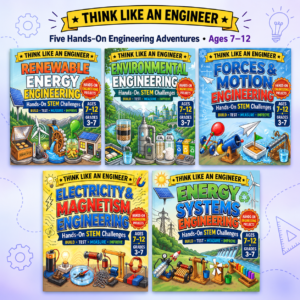
Part of the Think Like an Engineer Series
Environmental Engineering is the fifth and final book in the Think Like an Engineer series:
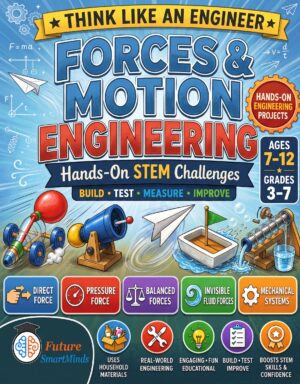
- Forces & Motion Engineering
- Electricity & Magnetism Engineering
- Energy Systems Engineering
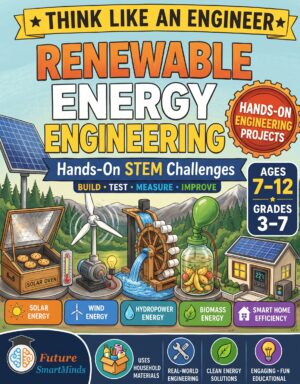
- Renewable Energy Engineering
- Environmental Engineering
Together, the five books introduce children to engineering through practical challenges involving motion, electricity, energy, renewable systems, and environmental solutions.
Each book reinforces the engineering process of planning, building, testing, measuring, troubleshooting, and improving designs.
From containing oil spills and filtering water to investigating carbon capture and recovering useful materials, discover how engineers turn environmental challenges into practical solutions.
Start building, testing, measuring, and improving—and inspire the next generation of environmental engineers!