Description
Grow Your Money: Hands-On Financial Literacy Adventures for Kids Ages 7–12
Explore interest, compound growth, investing, inflation, risk, and diversification through practical financial literacy activities!
What makes money grow—and why can having more dollars sometimes mean having less buying power?
In Grow Your Money, young learners ages 7–12 explore how time, interest, investment returns, inflation, and financial decisions affect the future value of money.
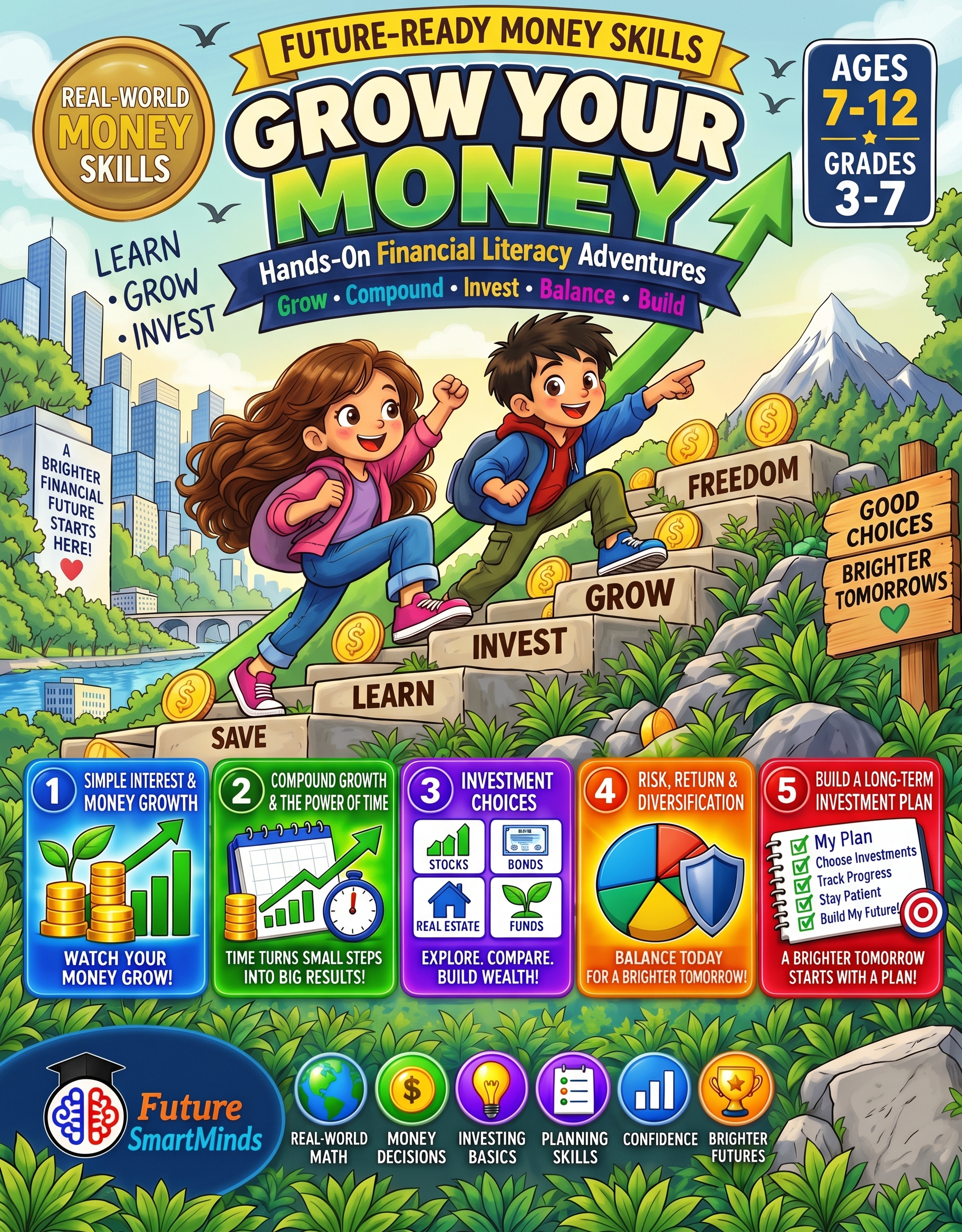
Through five connected financial literacy levels, children move beyond basic saving to understand simple interest, compound growth, investment choices, risk and diversification, and long-term financial planning.
Rather than simply learning financial vocabulary, children calculate, compare, evaluate, decide, and explain using real-world examples, guided mathematics, and thoughtful financial scenarios.
Part of the five-book Future-Ready Money Skills series, Grow Your Money helps children discover that growing money isn’t about getting rich quickly. It is about understanding time, return, purchasing power, uncertainty, and the importance of making decisions that fit a financial goal.
Our learning approach: GROW → COMPOUND → INVEST → BALANCE → BUILD
Five Connected Money-Growth Levels
Level 1 — Simple Interest & Money Growth
Discover how money can earn interest over time.
Explore principal, interest rate, time, interest earned, and ending balance. Use real-world examples to calculate simple interest and compare different savings scenarios.
Investigate inflation and discover why an increase in the number of dollars does not always mean an increase in purchasing power.
Skills developed: Simple-interest calculations, percentages, comparing returns, understanding inflation, and evaluating purchasing power.
Level 2 — Compound Growth & the Power of Time
Explore how money can grow when interest is added to a balance and future interest is calculated on the new amount.
Investigate compound interest, future value, annual percentage yield (APY), compounding frequency, and regular contributions.
Compare growth over different periods and discover why starting earlier can give money more time to compound.
Skills developed: Compound-growth calculations, interest rates, contributions, comparing savings options, and long-term financial reasoning.
Level 3 — Investment Choices: Stocks, Bonds, Funds & Real Estate
Discover what different investment types represent and how they may generate income or change in value.
Explore four important investing concepts:
- OWN: Understand stocks as ownership interests in companies.
- LEND: Explore bonds as a way of lending money to an issuer.
- COMBINE: Discover how investment funds hold collections of assets.
- PROPERTY: Learn how real estate can generate income and change in value.
Compare potential dividends, bond interest, investment returns, liquidity, and the characteristics of different assets.
Skills developed: Investment literacy, comparing asset types, recognizing sources of returns, understanding liquidity, and evaluating financial choices.
Level 4 — Investment Risk, Return & Diversification
Explore why investment returns are uncertain and why greater potential growth can come with greater risk.
Investigate volatility, time horizon, risk tolerance, concentration, diversification, portfolios, and asset allocation.
Compare investment approaches for different financial goals, considering growth potential, stability, and access to money.
Discover why diversification can reduce dependence on a single investment without eliminating all risk.
Skills developed: Risk assessment, return comparisons, diversification, portfolio thinking, and balancing financial priorities.
Level 5 — Build a Long-Term Investment Plan
Complete the capstone by designing a long-term investment plan that connects all the concepts introduced throughout the book.
Identify a financial goal, estimate a time horizon, choose contributions, consider inflation and purchasing power, compare investment choices, and create an allocation strategy.
Investigate how diversification and rebalancing can help maintain a plan as circumstances change.
Evaluate the plan and make one of three decisions:
READY → REVISE → RETHINK
Skills developed: Investment planning, goal-setting, financial calculations, portfolio allocation, diversification, and evidence-based decision-making.
More Than Basic Investing Worksheets
Grow Your Money introduces investing concepts through connected lessons that encourage mathematical thinking and informed decisions.
Each level combines explanations, visual examples, realistic calculations, and activities that strengthen financial reasoning.
- Mental Workout: Solve practical questions involving interest, inflation, investments, and financial choices.
- Future-Ready Challenge: Reconsider decisions when interest rates, contributions, investment conditions, or financial goals change.
- Reflect & Explain: Justify choices, explain calculations, and consider alternative approaches.
The emphasis is on understanding how money, time, growth, and risk interact—not predicting which investment will perform best.
What Children Will Learn
- Calculate simple interest and ending balances.
- Understand how inflation affects purchasing power.
- Explore compound interest, compounding frequency, and APY.
- Calculate and compare growth involving time and regular contributions.
- Discover what stocks, bonds, investment funds, and real estate represent.
- Recognize different sources of investment income and returns.
- Understand that investment values can rise or fall.
- Compare risk, volatility, liquidity, and time horizons.
- Explore diversification, asset allocation, and portfolio rebalancing.
- Create a long-term investment plan based on a goal and financial priorities.
- Explain financial decisions using calculations, evidence, and thoughtful reasoning.
What’s Included in the PDF Book
- Five connected financial literacy learning levels.
- Clear, student-friendly explanations and visual examples.
- Realistic examples of saving, interest, inflation, and investing.
- Worked financial calculations and comparison activities.
- Mental Workouts for practical problem-solving.
- Future-Ready Challenges encouraging deeper analysis.
- Reflect & Explain questions.
- A final Build a Long-Term Investment Plan capstone project.
- A complete answer key with sample reasoning.
Understanding the Power of Time and Financial Choices
Growing money involves more than choosing an account or investment with an attractive advertised return.
Throughout this book, children investigate practical questions such as:
- How much interest will my money earn?
- How does compound growth differ from simple interest?
- Why can starting earlier make a difference?
- How does inflation affect what money can buy?
- What is the difference between owning a stock and holding a bond?
- Why might an investment with a higher potential return also involve more risk?
- How can diversification help manage investment risk?
- Does my financial plan match my goal, timeline, and need for access to money?
These activities encourage children to connect financial calculations with real-world decisions and understand why long-term planning requires both opportunity and caution.
Who Is This Book For?
Designed for children ages 7–12, including:
- Parents introducing interest, investing, and financial growth.
- Homeschool families teaching financial literacy and real-world mathematics.
- Teachers planning lessons on compound interest, inflation, and investing.
- Students in Grades 3–7 developing money-management and reasoning skills.
- Young learners curious about stocks, bonds, and how investments work.
- Classroom enrichment, financial literacy, and life-skills activities.
Digital PDF Edition
Purchase the illustrated PDF edition directly from Future Smart Minds and download your book after checkout.
Read it on a compatible computer or tablet, or print selected learning pages in accordance with the licence supplied with your purchase.
Prefer a physical book? The paperback edition is available separately through Amazon.
Part of the Future-Ready Money Skills Series
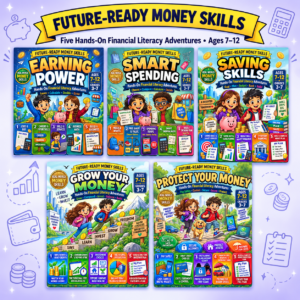
Grow Your Money is Book 4 of 5 in the Future-Ready Money Skills collection:
- Earning Power — Understand how money is earned.
- Smart Spending — Make thoughtful spending decisions.
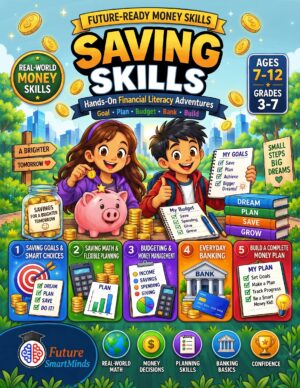
- Saving Skills — Set goals, create budgets, and manage money.
- Grow Your Money — Explore interest, investing, and financial growth.
- Protect Your Money — Develop safe payment habits and protect financial information.
Together, the five books guide young learners through the financial learning journey:
EARN → SPEND → SAVE → GROW → PROTECT
Growing money isn’t about getting rich quickly. It is about understanding how time, returns, inflation, risk, and thoughtful choices can shape financial outcomes.
Learn. Grow. Invest. Balance. Build for the future!