Description
Saving Skills: Hands-On Financial Literacy Adventures for Kids Ages 7–12
Set saving goals, build realistic budgets, understand everyday banking, and develop stronger money-management habits!
Help children move from “I want to save” to “I know how to make a plan.”
In Saving Skills, young learners ages 7–12 discover how to set meaningful saving goals, calculate the money and time needed to reach them, organize spending and saving priorities, track transactions, and adapt when financial circumstances change.
Through five connected financial literacy levels, children build practical skills in saving, budgeting, banking, and personal money management using realistic examples, guided calculations, and decision-making challenges.
Rather than simply memorizing money vocabulary, learners calculate, compare, evaluate, decide, adjust, and explain their choices through real-world scenarios.
Part of the five-book Future-Ready Money Skills series, this book shows that saving wisely is not just about putting money aside. It is about understanding what money should accomplish, developing a realistic plan, monitoring progress, and making thoughtful adjustments.
Our learning approach: GOAL → ADAPT → ALLOCATE → TRACK → BUILD
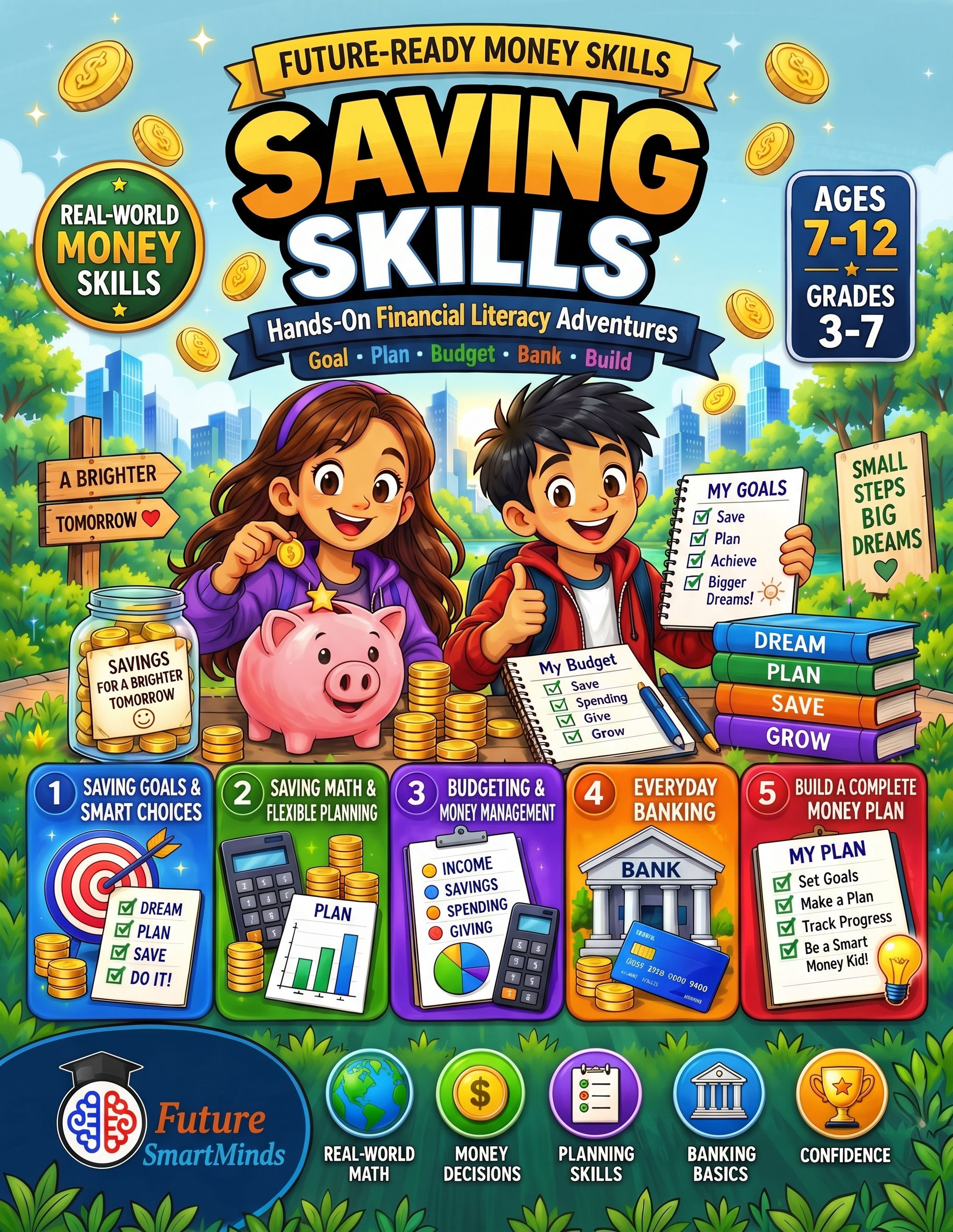
Five Connected Saving Skills Levels
Level 1 — Saving Goals & Smart Choices
Discover how purposeful saving begins with understanding what matters.
Explore short-, medium-, and longer-term saving goals, priorities, delayed gratification, target amounts, deadlines, and emergency savings.
Investigate how different goals compete for limited money and why a strong saving decision should consider purpose, amount, time, and priority.
Skills developed: Goal-setting, prioritization, saving decisions, delayed gratification, and planning ahead.
Level 2 — Saving Math & Flexible Planning
Learn how to turn a saving goal into a realistic plan using three essential elements:
AMOUNT → TIME → CONTRIBUTION
Calculate how much to save each week or month, estimate the time needed to reach a target, and track progress toward a goal.
Compare Planned vs. Actual savings and identify whether a plan is Ahead, On Track, or Behind.
Investigate what happens when contributions, prices, or deadlines change, and recalculate a new plan to respond to the situation.
Skills developed: Saving calculations, timelines, progress tracking, comparing planned and actual results, and flexible decision-making.
Level 3 — Budgeting & Money Management
Discover how a budget helps give available money useful jobs.
Explore the Spend • Save • Give approach, Pay Yourself First, category budgeting, the 50/30/20 guideline, and simplified zero-based budgeting.
Allocate money among priorities, compare budgeting approaches, identify surplus or shortfall, and adjust allocations when needs or circumstances change.
Skills developed: Budget creation, money allocation, percentages, prioritization, identifying shortfalls, and financial planning.
Level 4 — Everyday Banking: Accounts, Transactions & Tracking
Learn how everyday checking and savings accounts work and how to keep accurate money records.
Explore deposits, purchases, withdrawals, transfers, fees, and interest.
Investigate running balances, bank statements, posted and pending transactions, available balances, and simple reconciliation.
Practise recording transactions, calculating balances, and identifying differences between personal records and banking information.
Skills developed: Banking literacy, transaction tracking, balance calculations, reading statements, reconciliation, and financial organization.
Level 5 — Build a Complete Money Plan
Complete the capstone by connecting everything learned throughout the book into one practical money-management plan.
Set a meaningful saving goal, calculate contributions, organize a budget, include emergency savings, track transactions, and respond to changes in money available or spending priorities.
Use calculations and evidence to evaluate whether the final plan is realistic and sustainable.
Conclude by making one of three decisions:
READY → REVISE → RETHINK
Skills developed: Integrated financial planning, saving and budgeting, money tracking, adapting to changes, and evidence-based decision-making.
More Than Saving Worksheets
Saving Skills helps children understand how practical money management works in everyday life.
Each level combines student-friendly explanations, visual examples, realistic calculations, and activities that encourage careful reasoning.
- Mental Workout: Solve real-world saving, budgeting, and banking problems.
- Future-Ready Challenge: Adapt plans when circumstances change and reconsider earlier decisions.
- Reflect & Explain: Explain calculations, justify financial choices, and evaluate alternative approaches.
These activities emphasize understanding, flexibility, and reasoning—not simply finding one correct answer.
What Children Will Learn
- Set meaningful short-, medium-, and longer-term saving goals.
- Prioritize financial goals and understand delayed gratification.
- Calculate saving contributions, deadlines, and progress.
- Compare planned savings with actual results.
- Adjust saving plans when prices, contributions, or timelines change.
- Create budgets using practical money-allocation methods.
- Explore Spend • Save • Give, Pay Yourself First, and simplified budgeting approaches.
- Understand checking and savings accounts.
- Record deposits, purchases, withdrawals, transfers, and fees.
- Calculate running balances and distinguish posted from pending transactions.
- Read simplified account statements and reconcile money records.
- Build a complete financial plan and explain how it can adapt over time.
What’s Included in the PDF Book
- Five connected saving and money-management learning levels.
- Clear, student-friendly explanations and visual examples.
- Real-world saving, budgeting, and banking scenarios.
- Worked calculations and guided financial planning activities.
- Mental Workouts for practical problem-solving.
- Future-Ready Challenges requiring deeper reasoning and adjustment.
- Reflect & Explain questions.
- A final Build a Complete Money Plan capstone project.
- A complete answer key with sample reasoning.
Connecting Money Math to Everyday Life
Saving becomes more meaningful when children understand how everyday choices affect financial progress.
Throughout the book, learners practise mathematical skills such as addition, subtraction, multiplication, division, percentages, comparisons, and multi-step calculations.
They use these skills to investigate practical questions:
- How much should I save each week to reach my goal?
- What happens if the price of something I want increases?
- Am I ahead of or behind my saving plan?
- How should I divide money among spending, saving, and giving?
- What should I change when unexpected expenses arise?
- Why might my available bank balance differ from the balance shown on a statement?
- Is my complete money plan ready, or should I revise it?
By exploring realistic situations, children begin to see saving, budgeting, and banking as connected parts of responsible money management.
Who Is This Book For?
Designed for children ages 7–12, including:
- Parents introducing saving and money-management habits.
- Homeschool families teaching practical financial literacy.
- Teachers planning saving, budgeting, or banking lessons.
- Students in Grades 3–7 developing real-world math skills.
- Young learners preparing to manage allowances, gifts, or earned money.
- Classroom enrichment, life-skills, and personal finance activities.
Digital PDF Edition
Purchase the illustrated PDF edition directly from Future Smart Minds and download your book after checkout.
Read it on a compatible computer or tablet, or print selected learning pages in accordance with the licence supplied with your purchase.
Prefer a physical book? The paperback edition is available separately through Amazon.
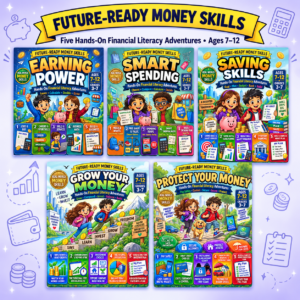
Part of the Future-Ready Money Skills Series
Saving Skills is Book 3 of 5 in the Future-Ready Money Skills collection:
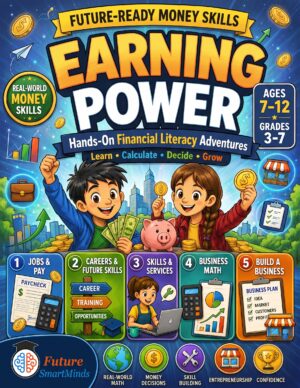
- Earning Power — Understand how money is earned.
- Smart Spending — Make thoughtful spending and purchasing decisions.
- Saving Skills — Set saving goals, create budgets, and manage money.
- Grow Your Money — Explore interest, investing, and financial growth.
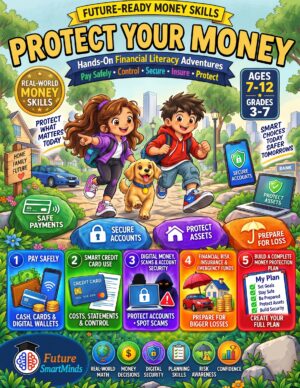
- Protect Your Money — Develop safe payment habits and protect financial information.
Together, these five books follow the practical financial learning journey:
EARN → SPEND → SAVE → GROW → PROTECT
Saving wisely is not simply about putting money aside. It is about knowing what you want money to accomplish, creating a realistic plan, tracking results, and adjusting with confidence.
Set goals. Build plans. Track progress. Develop stronger money habits for the future!