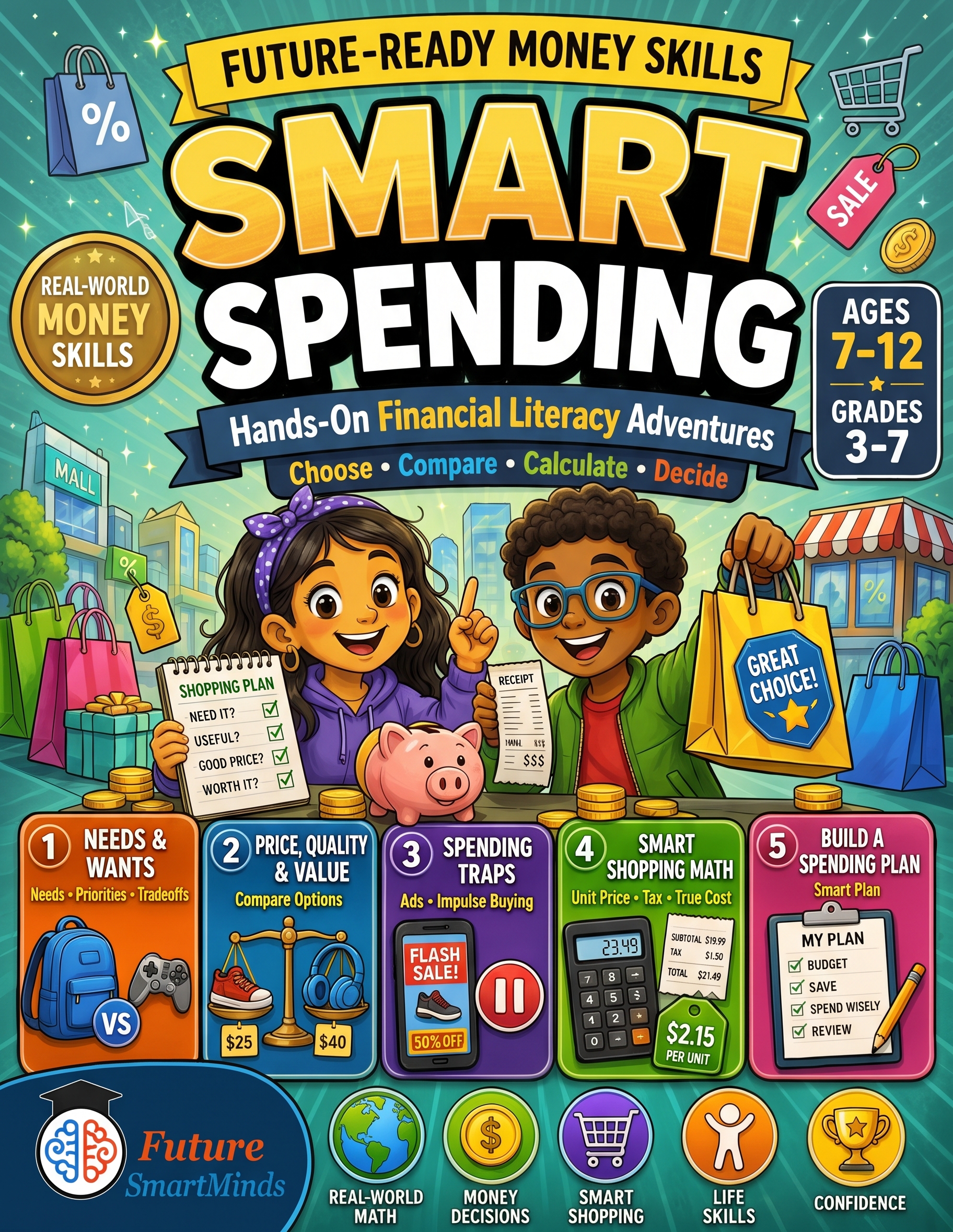
Description
Smart Spending: Hands-On Financial Literacy Adventures for Kids Ages 7–12
Learn to prioritize purchases, compare value, recognize spending traps, calculate true costs, and make thoughtful money decisions!
Help children become confident, informed spenders in a world filled with shopping choices, advertising, trends, online purchases, and tempting discounts.
In Smart Spending, young learners ages 7–12 explore practical money-management skills through realistic examples, engaging financial literacy lessons, consumer math, and thoughtful decision-making activities.
Across five connected learning levels, children discover how to distinguish needs from wants, evaluate price and quality, recognize outside spending pressure, calculate the complete cost of purchases, and create a spending plan they can explain and defend.
Rather than simply completing isolated worksheets, learners calculate, compare, evaluate, decide, and explain their choices using evidence and real-world reasoning.
Part of the five-book Future-Ready Money Skills series, this book helps children understand that smart spending isn’t about always buying the cheapest product or avoiding everything enjoyable. It’s about understanding priorities, recognizing value, and making purposeful decisions.
Our learning approach: PRIORITIZE → EVALUATE → RESIST → CALCULATE → PLAN
Five Connected Smart Spending Levels
Level 1 — Needs, Wants, Values & Tradeoffs
Discover how to distinguish needs from wants while recognizing that spending priorities can depend on individual circumstances.
Explore personal values, financial priorities, the Spend • Save • Give framework, tradeoffs, and opportunity cost.
Investigate how choosing one purchase can mean giving up another opportunity and why thoughtful spending begins with understanding what matters most.
Skills developed: Prioritizing, recognizing needs and wants, weighing tradeoffs, opportunity cost, and financial decision-making.
Level 2 — Price, Quality & Value
Learn why the lowest price isn’t always the best choice—and why paying more doesn’t automatically mean getting better value.
Compare products using price, quality, usefulness, durability, frequency of use, and cost per use.
Evaluate realistic shopping options to decide which choice provides the greatest value for a specific need.
Skills developed: Product comparison, value assessment, cost-per-use calculations, and evidence-based purchasing decisions.
Level 3 — Spending Traps & Smart Decisions
Investigate how advertising, urgency, fear of missing out (FOMO), trends, influencers, peer pressure, and easy digital purchasing can affect spending decisions.
Explore real-world examples involving online shopping, digital payments, one-click purchases, and impulse buying.
Practise the PAUSE strategy to slow down, recognize pressure, compare alternatives, and make thoughtful choices.
Skills developed: Consumer awareness, recognizing advertising influence, resisting impulse spending, and independent decision-making.
Level 4 — Smart Shopping Math: Compare the True Cost
Develop practical consumer math skills by calculating what purchases actually cost.
Explore unit prices, percentage discounts, multi-buy offers, sales taxes, shipping charges, delivery fees, service fees, and tips.
Compare advertised prices with final checkout totals, evaluate different offers, and understand why a large discount doesn’t always represent the best deal.
Skills developed: Unit-price comparisons, percentages, discounts, taxes, fees, multi-step calculations, and true-cost evaluation.
Level 5 — Build a Smart Spending Plan
Complete the capstone by creating a practical spending plan using the skills developed throughout the book.
Follow an 8-step Smart Spending Plan to establish priorities, research alternatives, compare product value, recognize spending pressure, apply the PAUSE strategy, calculate true costs, consider tradeoffs, and defend a final decision.
Use mathematical calculations and clear reasoning to demonstrate why a purchase makes sense.
Skills developed: Spending plans, budgeting decisions, consumer research, comparison shopping, financial reasoning, and decision-making.
More Than Money Worksheets
Smart Spending encourages children to use financial knowledge to make thoughtful real-world decisions.
Each level combines clear explanations, visual examples, and practical activities designed to strengthen both consumer awareness and mathematical reasoning.
- Mental Workout: Calculate, compare, evaluate, decide, and explain through realistic spending scenarios.
- Future-Ready Challenge: Reconsider financial decisions when conditions, prices, or circumstances change.
- Reflect & Explain: Explain reasoning, justify choices, and consider alternative approaches.
The result is a learning experience that emphasizes understanding and reasoning—not just getting the calculation right.
What Children Will Learn
- Distinguish needs from wants while considering personal circumstances and priorities.
- Understand values, tradeoffs, and opportunity cost.
- Compare products based on price, quality, durability, and usefulness.
- Calculate cost per use and identify better-value purchases.
- Recognize advertising, social pressure, FOMO, and impulse spending.
- Use the PAUSE strategy to make more intentional decisions.
- Calculate unit prices, discounts, sales taxes, shipping charges, fees, and tips.
- Evaluate multi-buy deals and determine the true cost of purchases.
- Develop an organized spending plan.
- Explain and defend decisions using evidence and mathematical reasoning.
What’s Included in the PDF Book
- Five connected financial literacy learning levels.
- Clear, student-friendly lessons and visual examples.
- Modern shopping scenarios involving online purchases, advertising, and digital spending.
- Worked real-world consumer math calculations.
- Mental Workouts for applied financial problem-solving.
- Future-Ready Challenges requiring deeper reasoning.
- Reflect & Explain questions.
- An 8-step Smart Spending Plan capstone project.
- A complete answer key.
Connecting Consumer Math to Real Life
Children encounter spending choices everywhere—from school supplies and everyday purchases to online shops, food-delivery apps, and digital entertainment.
Throughout the book, they practise mathematical skills such as multiplication, division, percentages, comparison, estimation, and multi-step calculations.
They use these skills to answer practical questions:
- Is this something I need or simply want right now?
- Which product offers better long-term value?
- Am I being influenced by advertising or urgency?
- Is a multi-buy offer really cheaper?
- What will I actually pay after taxes and extra fees?
- Can I explain why my final purchase is a smart choice?
By working through realistic examples, children learn to connect financial decisions with priorities, calculations, and evidence.
Who Is This Book For?
Designed for children ages 7–12, including:
- Parents introducing money management and smart shopping habits.
- Homeschool families teaching personal finance and consumer math.
- Teachers planning financial literacy lessons.
- Students in Grades 3–7 developing real-world math skills.
- Young learners exploring budgeting, comparison shopping, and consumer choices.
- Classroom enrichment and life-skills activities.
Digital PDF Edition
Purchase the illustrated PDF edition directly from Future Smart Minds and download your book after checkout.
Read on a compatible computer or tablet, or print selected learning pages in accordance with the licence supplied with your purchase.
Prefer a physical book? The paperback edition is available separately through Amazon.
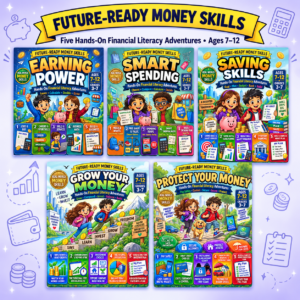
Part of the Future-Ready Money Skills Series
Smart Spending is Book 2 of 5 in the Future-Ready Money Skills collection:
- Earning Power — Understand how money is earned.
- Smart Spending — Make thoughtful spending and purchasing decisions.
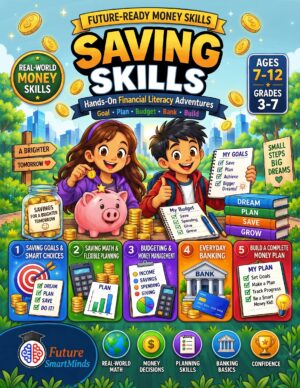
- Saving Skills — Set saving goals and build practical saving habits.
- Grow Your Money — Explore interest, investing, and financial growth.
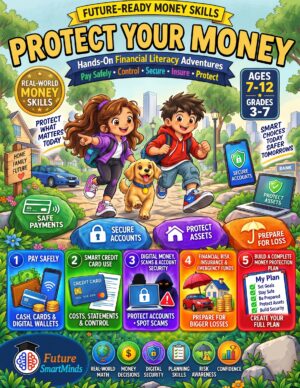
- Protect Your Money — Develop safe payment habits and protect financial information.
Together, these five books guide children through the financial learning journey:
EARN → SPEND → SAVE → GROW → PROTECT
Smart spending doesn’t mean always choosing the cheapest product or never buying something fun. It means understanding what matters, recognizing outside pressure, comparing value, calculating complete costs, and making choices on purpose.
Choose smarter today. Build money skills for tomorrow!