Description
Protect Your Money: Hands-On Financial Literacy Adventures for Kids Ages 7–12
Learn to pay safely, control credit, recognize scams, secure financial accounts, prepare for emergencies, and manage financial risks!
How do you protect money when making a payment, borrowing, shopping online, encountering a scam, or facing an unexpected financial loss?
In Protect Your Money, children ages 7–12 discover practical ways to keep money and financial information safer through realistic scenarios, guided calculations, and thoughtful decision-making activities.
Through five connected financial literacy levels, young learners explore safe payment methods, responsible credit-card use, digital money and account security, financial risk and insurance, and the development of a complete Money Protection Plan.
Rather than simply memorizing financial terms, children calculate, compare, evaluate, verify, decide, and explain their choices using evidence and real-world examples.
Part of the five-book Future-Ready Money Skills series, Protect Your Money completes the financial learning journey by showing children how to protect the money they earn, spend, save, and grow.
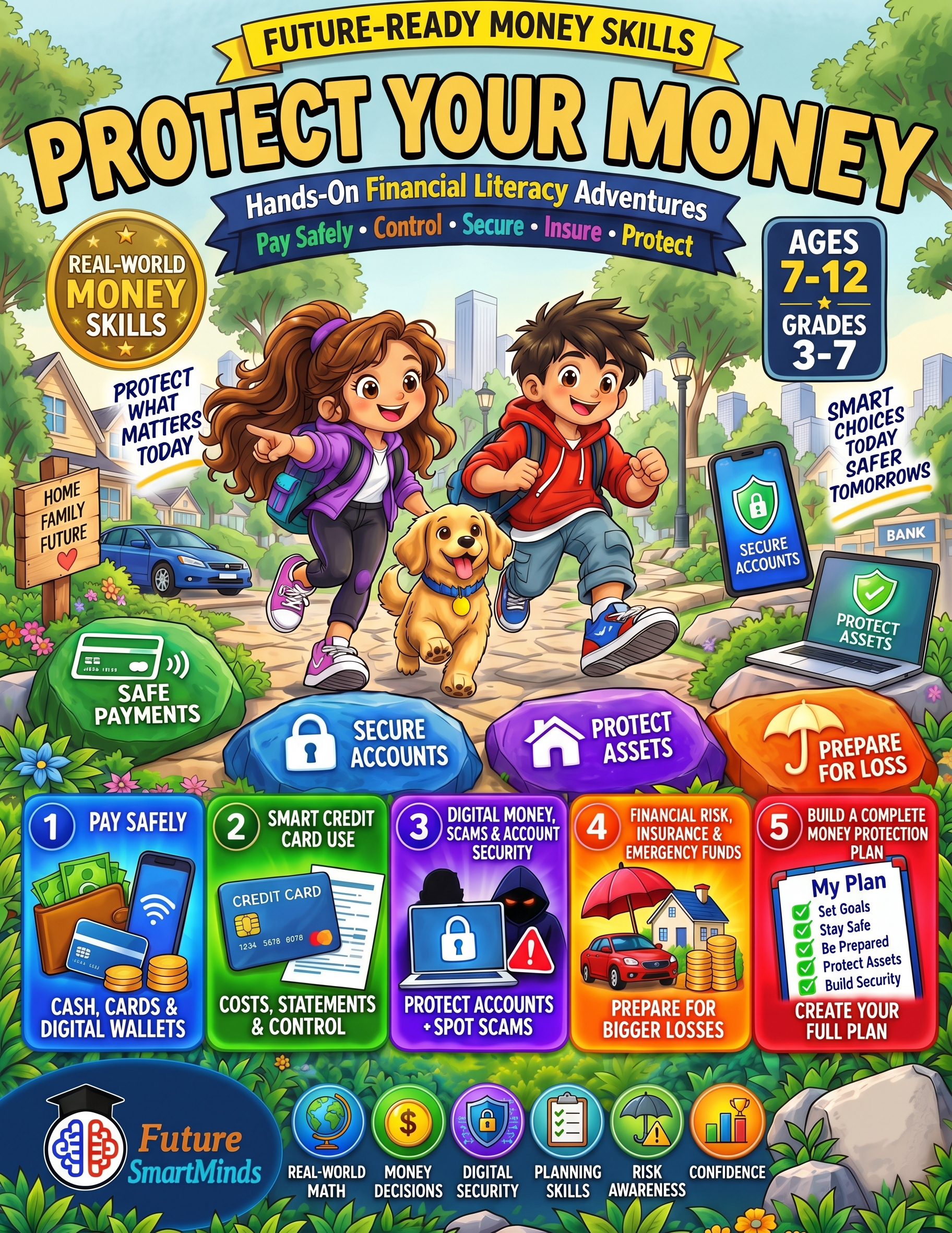
Our learning approach: PAY SAFELY → CONTROL → SECURE → INSURE → PROTECT
Five Connected Money-Protection Levels
Level 1 — Pay Safely: Cash, Cards & Digital Wallets
Learn how different payment methods work and why each requires appropriate precautions.
Compare cash, debit cards, credit cards, prepaid cards, and digital wallets. Explore how payments are authorized, how to protect PINs and financial information, and why checking transaction details matters.
Practise a four-step payment safety approach:
CHECK → PAY → PROTECT → VERIFY
Investigate realistic purchasing situations and decide which payment methods and safety precautions are appropriate.
Skills developed: Payment-method comparison, transaction checking, PIN protection, payment verification, and safe financial decisions.
Level 2 — Smart Credit Card Use: Costs, Statements & Control
Explore how credit cards work and why borrowing money requires careful management.
Learn about credit limits, outstanding balances, statements, due dates, minimum payments, annual percentage rates (APR), interest charges, fees, and cash advances.
Compare paying a statement balance in full with carrying an unpaid balance. Investigate how repayment decisions influence borrowing costs and financial flexibility.
Discover how responsible credit use can affect credit history and credit scores, and how borrowing concepts connect to larger financial commitments such as car loans and mortgages.
Skills developed: Credit-card statement reading, interest and fee calculations, repayment comparisons, responsible borrowing, and financial planning.
Level 3 — Digital Money, Scams & Account Security
Discover how to protect money and personal information when shopping, paying, and managing accounts online.
Explore digital payments, subscriptions, free trials, automatic renewals, passwords, multi-factor authentication (MFA), verification codes, phishing attempts, and unauthorized transactions.
Investigate how scammers use urgency, impersonation, and professional-looking messages to encourage unsafe decisions.
Learn why suspicious requests should be checked through a trusted, independently verified contact method rather than relying on links or instructions provided in the message.
Skills developed: Digital payment awareness, subscription-cost calculations, scam recognition, password security, account verification, and safer online decisions.
Level 4 — Financial Risk, Insurance & Emergency Funds
Discover why unexpected financial losses can happen and how planning helps reduce their impact.
Explore practical risk-management choices, including reducing risks, retaining manageable risks, preparing emergency savings, and transferring eligible financial risks through insurance.
Learn about insurance premiums, deductibles, coverage, claims, exclusions, and reimbursements through simplified examples involving cars, homes, pets, travel, and unexpected costs.
Investigate how emergency funds and insurance serve different purposes: savings can help cover smaller or immediate expenses, while insurance may provide protection against specified larger losses.
Skills developed: Risk assessment, emergency-fund planning, premiums and deductibles, reimbursement calculations, and financial decision-making.
Level 5 — Build a Complete Money Protection Plan
Complete the capstone by connecting everything learned throughout the book into one practical financial protection plan.
Map payments and credit-card charges, reserve money for repayment, identify recurring digital costs, secure financial accounts, and prepare for unexpected expenses.
Evaluate which smaller financial losses could be managed through emergency savings and which larger risks may require insurance or other protective measures.
Use calculations, evidence, and reasoning to build a plan that balances convenience, costs, access to money, and financial security.
Skills developed: Integrated money protection, payment planning, credit management, digital security, emergency preparation, and financial risk management.
More Than Money Safety Worksheets
Protect Your Money helps children understand financial protection through realistic situations and thoughtful decision-making.
Each level combines clear explanations, visual examples, worked calculations, and challenges that encourage practical financial reasoning.
- Mental Workout: Solve real-world problems involving payments, credit costs, subscriptions, scams, insurance, and unexpected expenses.
- Future-Ready Challenge: Reconsider financial decisions when costs, risks, or circumstances change.
- Reflect & Explain: Justify choices, explain calculations, and investigate safer alternatives.
The emphasis is on understanding how financial risks arise, choosing appropriate protections, and knowing how to respond.
What Children Will Learn
- Compare cash, debit cards, credit cards, prepaid cards, and digital wallets.
- Check payment details and protect PINs and account information.
- Understand credit limits, statements, minimum payments, APR, interest, and fees.
- Compare repayment strategies and recognize the cost of carrying credit-card debt.
- Identify subscriptions, free trials, automatic renewals, and recurring charges.
- Recognize phishing, suspicious messages, scams, and unauthorized transactions.
- Understand passwords, MFA, verification codes, and account security.
- Explore emergency savings and financial risk management.
- Understand insurance premiums, deductibles, coverage, exclusions, and claims.
- Calculate simplified insurance reimbursements and out-of-pocket expenses.
- Develop a complete Money Protection Plan using realistic financial decisions.
What’s Included in the PDF Book
- Five connected money-protection learning levels.
- Clear, student-friendly explanations and visual examples.
- Real-world examples involving payments, credit cards, digital spending, and financial risks.
- Worked calculations for balances, interest, recurring costs, deductibles, and reimbursements.
- Mental Workouts for practical financial problem-solving.
- Future-Ready Challenges encouraging deeper reasoning.
- Reflect & Explain questions.
- A final Build a Complete Money Protection Plan capstone project.
- A complete answer key with sample reasoning.
Connecting Money Protection to Everyday Life
Financial safety is increasingly important in a world of online shopping, digital payments, subscriptions, and financial accounts.
Throughout the book, learners practise mathematical skills such as addition, subtraction, multiplication, division, percentages, and multi-step calculations.
They apply these skills to questions such as:
- Which payment method is appropriate for this purchase?
- How can I verify that a transaction is correct?
- What happens when a credit-card balance is not paid in full?
- How much could a recurring subscription cost over a year?
- How should I respond to an unexpected request for a verification code?
- How much emergency savings might be needed for an unexpected expense?
- How do insurance deductibles and coverage affect out-of-pocket costs?
- Does my financial protection plan address the most important risks?
These scenarios help children connect mathematical reasoning with safer financial habits and responsible decisions.
Who Is This Book For?
Designed for children ages 7–12, including:
- Parents introducing financial safety and responsible money habits.
- Homeschool families teaching practical personal finance.
- Teachers planning lessons on digital money, credit, scams, or insurance.
- Students in Grades 3–7 developing real-world money and reasoning skills.
- Young learners preparing to understand modern payments and online financial risks.
- Classroom enrichment, financial literacy, and life-skills activities.
Digital PDF Edition
Purchase the illustrated PDF edition directly from Future Smart Minds and download your book after checkout.
Read it on a compatible computer or tablet, or print selected learning pages in accordance with the licence supplied with your purchase.
Prefer a physical book? The paperback edition is available separately through Amazon.
Part of the Future-Ready Money Skills Series
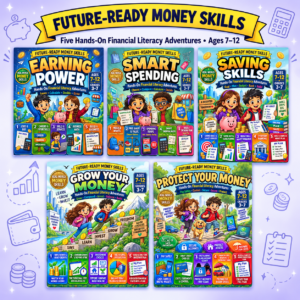
Protect Your Money is Book 5 of 5 in the Future-Ready Money Skills collection:
- Earning Power — Understand how money is earned.
- Smart Spending — Make thoughtful spending decisions.
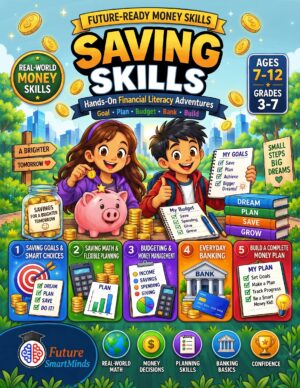
- Saving Skills — Set saving goals, create budgets, and manage money.
- Grow Your Money — Explore interest, investing, and financial growth.
- Protect Your Money — Develop safe payment habits, protect financial information, and prepare for financial risks.
Together, the five books complete the practical financial learning journey:
EARN → SPEND → SAVE → GROW → PROTECT
Protecting money isn’t about eliminating every risk. It is about understanding what could go wrong, choosing appropriate protections, and knowing how to respond.
Pay safely. Control credit. Stay secure. Prepare for risk. Protect what you build!