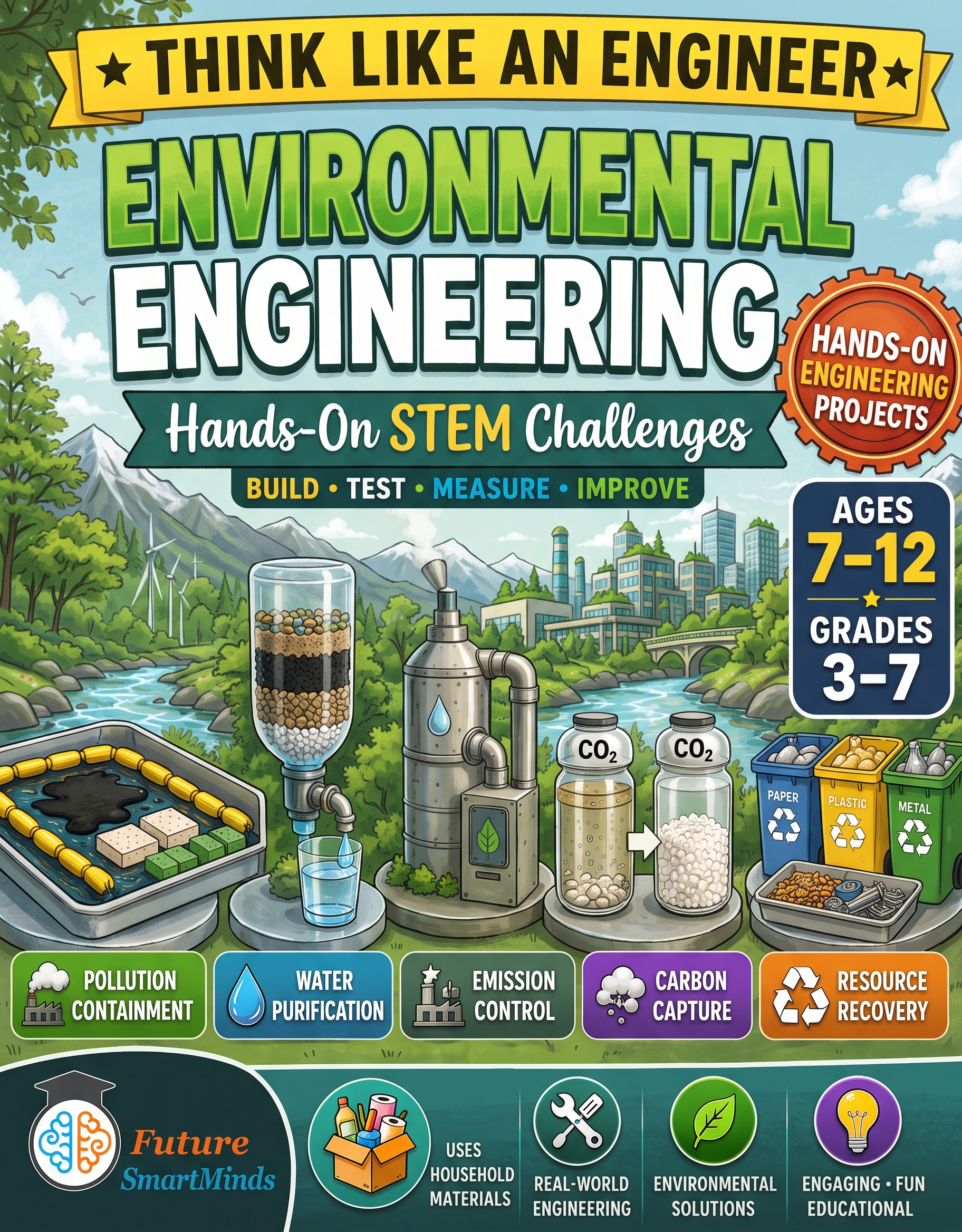
Discover hands-on engineering projects for kids ages 7–12 that turn scientific curiosity into working inventions. Across five connected books, young engineers explore forces, electricity, energy, and environmental solutions while developing creativity, problem-solving skills, and confidence through real engineering challenges. **PLAN → BUILD → TEST → MEASURE → IMPROVE**
Get the complete five-book collection in fillable and printable PDF format. Children can enter measurements, select answers, complete testing tables, and save their engineering notes digitally—or print the worksheets for hands-on learning at home or in the classroom.
Explore five exciting engineering fields, each with its own set of connected design challenges and a final capstone project. From launching air-powered cars and building electric motors to creating renewable energy systems and protecting the environment, every book offers a different way to put engineering into action.
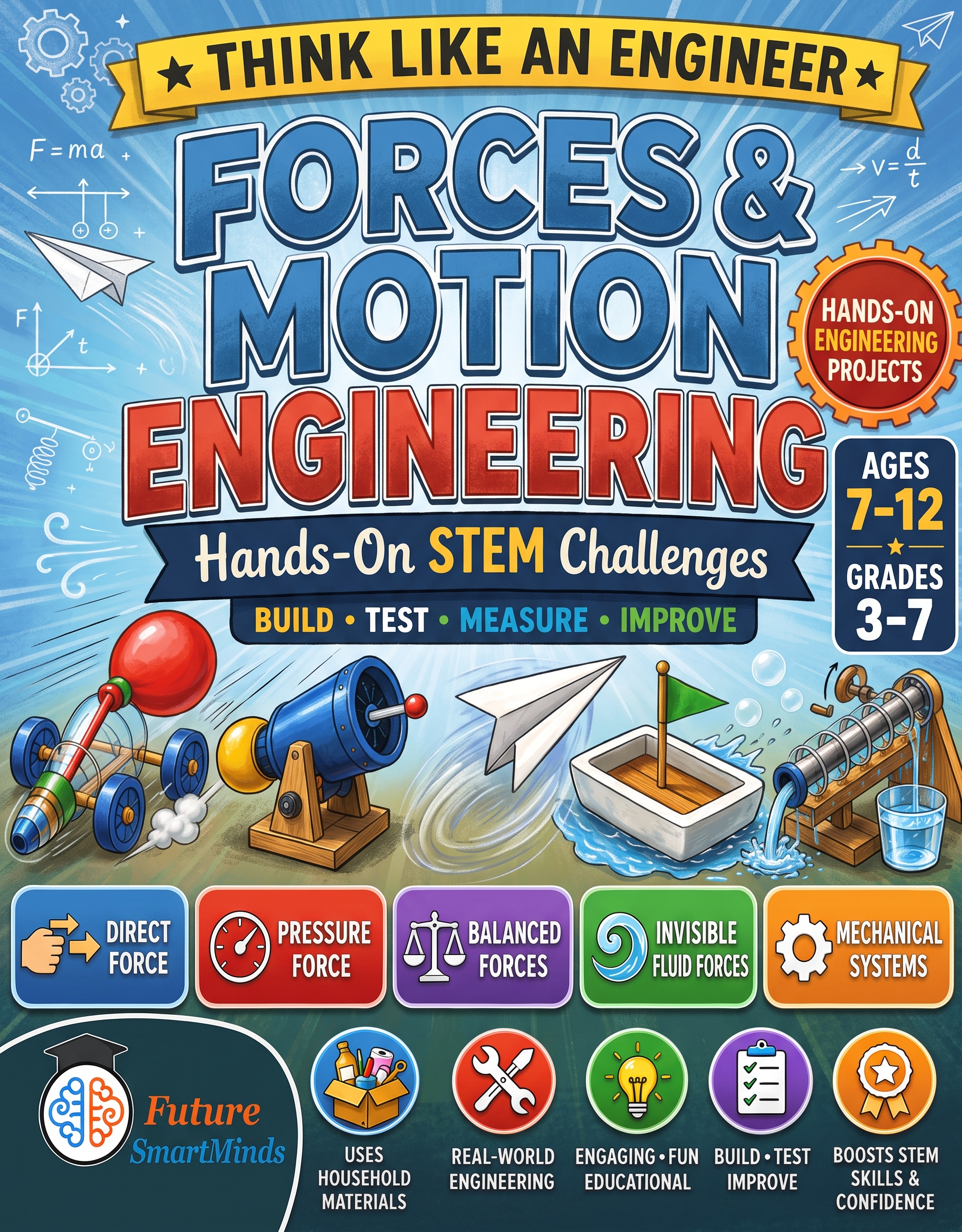
Cars, Air Pressure, Flight, Boats & Water-Lifting Systems
Discover how forces create movement through five complete engineering challenges. Children build a balloon-powered car, air cannon, turbo glider, soap-powered boat, and water-lifting screw system while investigating forces, motion, pressure, balance, and fluid behaviour. Every project encourages testing, measurement, troubleshooting, and redesign.
Learning highlights:
Fillable & Printable PDF · 73 Pages · $7.77
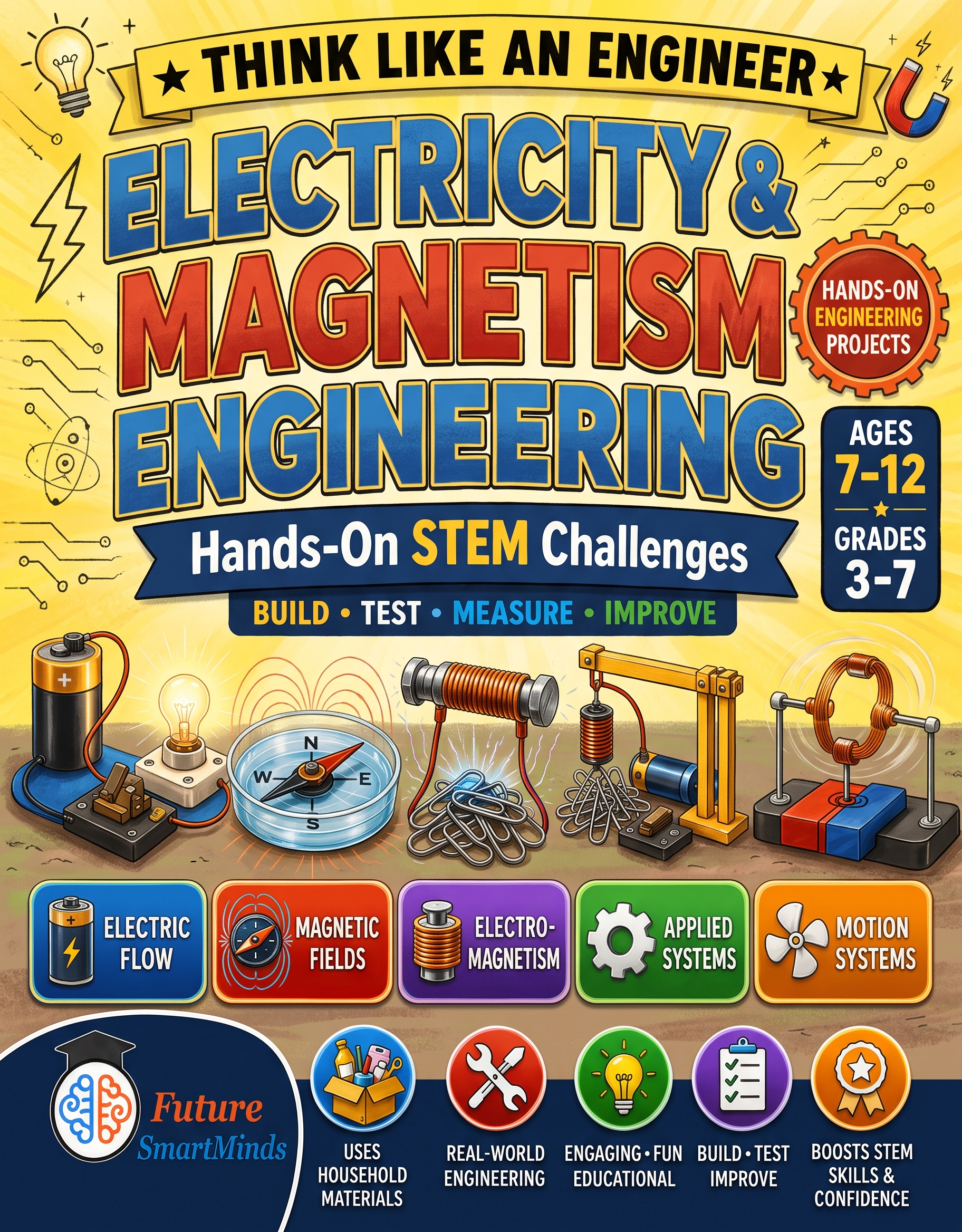
Electric Circuits, Magnetic Fields, Electromagnets, Cranes & Motors
Explore how electricity and magnetism work together to power useful technology. Across five connected projects, children build an electrical circuit, magnetic compass, electromagnet, electromagnetic crane, and spinning electric motor. They discover how simple electrical and magnetic concepts become controllable engineering systems.
Learning highlights:
Fillable & Printable PDF · 73 Pages · $7.77
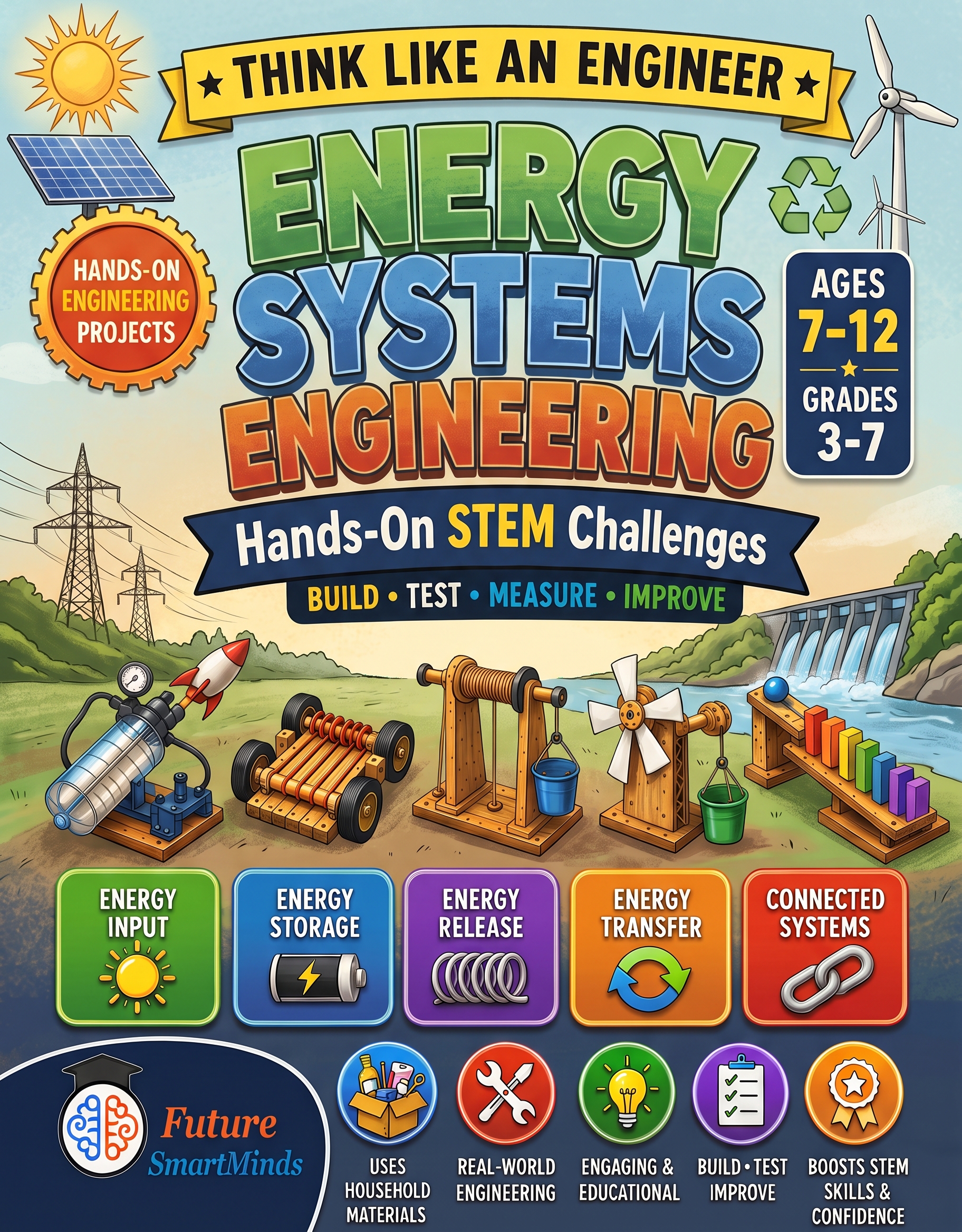
Air Launchers, Elastic Cars, Gravity Lifts, Wind Systems & Chain Reactions
Discover how energy can be stored, released, transferred, and transformed into motion. Children build a compressed-air launcher, rubber band-powered car, gravity-powered lift, wind-powered lifting system, and multi-stage chain reaction. Through testing and redesign, they learn how energy moves through connected systems and why reliability matters.
Learning highlights:
Fillable & Printable PDF · 73 Pages · $7.77
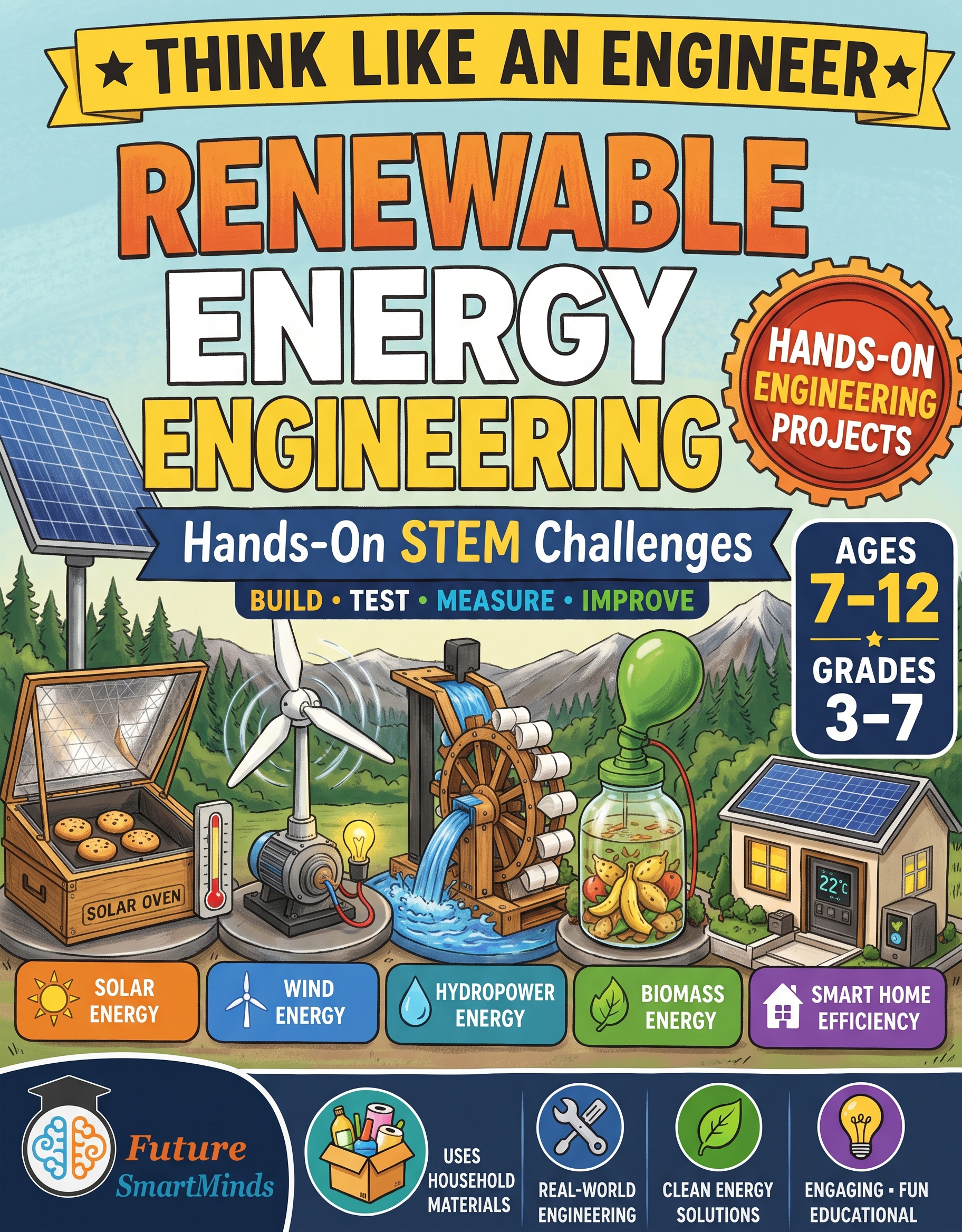
Solar, Wind, Hydropower, Biomass & Smart Energy Homes
Put renewable energy into action through five connected engineering challenges. Children design a solar oven, wind generator, hydropower generator, and mini biogas model before bringing energy-saving ideas together in a Smart Energy Home. They explore how renewable resources can be captured, converted, measured, and managed.
Learning highlights:
Fillable & Printable PDF · 73 Pages · $7.77
Pollution Control, Clean Water, Carbon Capture & Recycling
Discover how engineers solve environmental challenges by designing and testing practical systems. Children build an oil spill containment system, water filter, smokestack scrubber model, carbon capture mineralization system, and recycling recovery system. Each project connects a real environmental problem with a measurable engineering solution.
Learning highlights:
Fillable & Printable PDF · 73 Pages · $7.77
Five books designed to move beyond simply following instructions. Children build systems, investigate how they perform, and use evidence to make meaningful improvements.
Each book includes five complete projects that invite children to design, build, test, troubleshoot, and improve working systems—not simply watch a demonstration.
Children record observations, collect data, perform simple calculations, compare trials, and learn how engineers use measurements to make better decisions.
Each book develops engineering ideas across five related challenges, building toward a final project that combines important concepts and practical skills.
Illustrated instructions, accessible materials, interactive measurement tables, and reflection questions support learning at every stage. Children can type answers, select choices, record results, and save their progress—or print the worksheets for hands-on classroom activities.
Every engineering challenge encourages children to think beyond simply completing a project. They learn to observe performance, understand problems, and improve designs using evidence.
Understand the engineering challenge, explore the scientific ideas, and decide how the system should work.
Follow illustrated instructions to construct a working model using accessible materials.
Run the system, observe its behaviour, and investigate how different design choices affect performance.
Record observations and measurements in fillable testing tables, compare repeated trials, and use simple calculations to evaluate the system’s performance.
Identify weaknesses, change design variables, and retest to create a more effective and reliable system.
Flexible, hands-on engineering challenges for children, families, and educators who want to turn scientific understanding into practical problem-solving.
Children ages 7–12 who enjoy constructing models, exploring how things work, solving problems, and discovering new ways to improve their creations.
Enjoy meaningful engineering activities together at home using familiar materials, guided instructions, and opportunities to experiment and learn.
Introduce project-based STEM learning through structured engineering challenges that connect science, mathematics, design, and practical measurement.
Bring hands-on engineering into classrooms, makerspaces, enrichment programs, and STEM clubs through adaptable projects, testing activities, and improvement challenges.
Find answers about the engineering projects, required materials, learning experience, and purchasing options.
The series is designed for children ages 7–12 (approximately Grades 3–7). Younger learners may benefit from additional adult guidance, especially when constructing models, measuring results, or handling materials and tools.
Each book contains five complete engineering challenges rather than a large collection of quick experiments. Children build working systems, collect measurements, compare trials, troubleshoot problems, and complete improvement challenges. The emphasis is on understanding how a system performs and making it better.
No. Each book can be purchased separately as a downloadable PDF. You can choose the engineering field that interests your child or purchase the complete five-book collection at a discounted price.
Both options are available! Every Think Like an Engineer book includes fillable PDF worksheets that allow children to type measurements, select answers, complete tables, write notes, and record their observations directly in the PDF.
Students can save their completed work and return to it later using a compatible PDF reader, such as Adobe Acrobat Reader or PDF-XChange Editor.
Prefer learning on paper? The books are also fully printable, so children can complete activities and worksheets by hand.
Books contain five connected engineering projects, illustrated building instructions, materials lists, scientific explanations, testing and measurement activities, troubleshooting guidance, improvement challenges, and Reflect & Explain questions. Some books also include complete answer keys.
Most projects use familiar household, classroom, or craft materials, although some require simple electrical components, magnets, tubing, or measuring tools. Materials vary by activity, and adult supervision is needed for tasks involving cutting, assembly, electrical components, warm water, or prepared solutions. Activities should be completed following each book’s safety instructions.
Many activities are suitable for guided independent learning, but adult support is recommended when needed. Younger learners may need help with assembly, measurements, calculations, troubleshooting, or activities involving tools and materials that require supervision.
The collection contains five separate downloadable PDF books: Forces & Motion Engineering, Electricity & Magnetism Engineering, Energy Systems Engineering, Renewable Energy Engineering, and Environmental Engineering. Together, they provide 25 complete engineering challenges. Physical materials, printed books, and interactive online courses are not included.
After a successful purchase, WooCommerce provides access to the downloadable PDF files through your order’s download links. The complete series collection includes five separate PDF downloads.
Yes. Paperback editions are available separately through Amazon. Use the Amazon series link near the bottom of this page to explore individual titles and their current availability and prices.
Yes! Teachers can print the worksheets and activity pages for hands-on classroom learning. The fillable PDFs also give students the option to complete their measurements, answers, and reflections digitally.
For larger classroom groups, school-wide use, or multiple licences—for example, quantities exceeding 25 learners—please contact us at admin@futuresmartminds.com to discuss your needs.
From balloon-powered cars and spinning motors to renewable energy and environmental protection, give young learners the opportunity to design, build, measure, and improve systems that make science work.
Complete 5-Book PDF Collection
5 fillable and printable PDF books · 25 hands-on engineering challenges · Instant digital access
Love building and learning with a physical book? Explore the Think Like an Engineer paperback editions on Amazon and choose the engineering challenges that interest you.